
PA 12 Heat, Chemical and UV Resistance: Where SLS Parts Hold Up
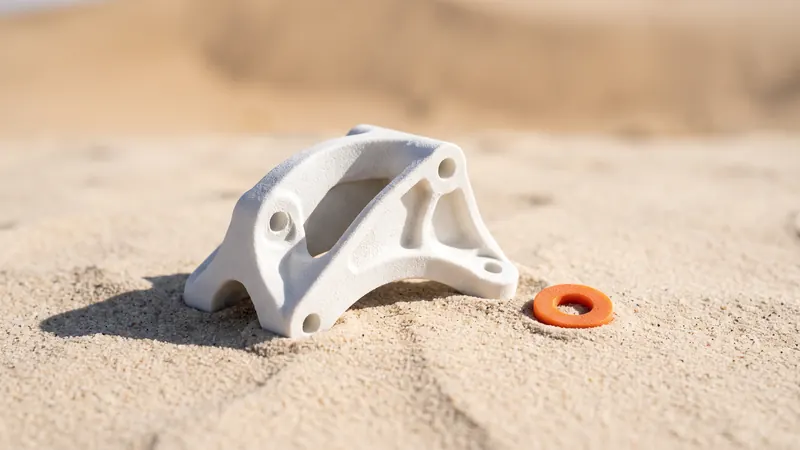
Before a printed part goes into a machine, a vehicle or outdoors, three questions come up: how warm can it get, which fluids can touch it, and how does it cope with sunlight? This guide answers them for laser-sintered PA 12 using only what EOS publishes for PA 2200, the powder we print, and says clearly where EOS publishes no value and testing is the only reliable answer.
Where the figures come from
We print white PA 12 from EOS's PA 2200 powder on an EOS FORMIGA P 110 Velocis. The thermal values below are from the current EOS data sheet for PA 2200 (process "Balance", 0.12 mm layers). The temperature range of use, the water absorption and the chemical resistance table are from EOS's product information for PA 2200. All are material values measured on test specimens. EOS itself notes that they are for information only and that the suitability of a part for a specific purpose has to be assessed by the user.
Heat resistance
| Property (EOS, PA 2200) | Value | Standard |
|---|---|---|
| Melting temperature | 176 °C | ISO 11357-1/-3 |
| Vicat softening temperature (B50), X | 176 °C | ISO 306 |
| Heat deflection temperature, 0.45 MPa | 157 °C (X), 145 °C (Z) | ISO 75-1/-2 |
| Heat deflection temperature, 1.80 MPa | 64 °C (X), 57 °C (Z) | ISO 75-1/-2 |
X means within the layers, Z across them. In its product information EOS adds two practical statements: PA 2200 parts show high mechanical strength and elasticity under steady stress in a temperature range from −40 °C to +80 °C, and short-time loading of the parts without stress is possible up to 160 °C.
What this means in practice
- Load matters more than temperature alone. The two heat deflection values show it: under a low load (0.45 MPa) the material keeps its shape up to well above 140 °C, under a higher load (1.80 MPa) only up to about 60 °C.
- Loaded parts: brackets, clamps, snap-fits and press fits that carry load should stay well below the 1.80 MPa values and be tested at their real working temperature.
- Unloaded parts: covers, guides and housings without stress tolerate short warm periods, up to the 160 °C EOS gives for short-time loading without stress.
- Creep: nylon slowly deforms under constant load, and more at higher temperature. Clamped screws and press fits in warm areas lose preload over time.
- Cold: EOS gives −40 °C as the lower end of the range of use. At low temperatures the material becomes stiffer and less forgiving in impacts.
Chemical resistance
PA 12 has few amide groups in its chain, which makes it more resistant to many chemicals and less sensitive to water than PA 6. EOS's product information for PA 2200 contains a resistance table (exposure of 6 months at 20 °C and 4 weeks at 60 °C). A selection of what it lists:
| Medium (EOS table) | 20 °C | 60 °C |
|---|---|---|
| Water, sea water | Resistant | Resistant |
| Petrol, fuel oil, petroleum, paraffin | Resistant | Resistant |
| Brake fluid, antifreeze, glycol | Resistant | Resistant |
| Silicone oil, linseed oil | Resistant | Resistant |
| Acetone | Resistant | Resistant |
| Sodium hydroxide solution, 50 % | Resistant | Resistant |
| Sodium chloride solution, ammonia solution | Resistant | Resistant |
| Hydrochloric acid, 10 % | Not resistant | Not resistant |
| Nitric acid, 10 % | Not resistant | Not resistant |
| Chromic acid, 10 % | Not resistant | Not resistant |
In short: oils, fuels, greases, many solvents and alkalis are generally fine; strong acids and oxidizing agents are not. Concentration, temperature, exposure time and mechanical stress all change the result, and stressed parts can crack in media that an unloaded sample survives. For a new medium, expose a printed sample under realistic conditions before you rely on it.
Water and humidity
EOS gives these water absorption values for PA 2200: 0.52 % at 23 °C and 50 % relative humidity, 1.33 % at 23 °C and 96 % relative humidity, and 1.93 % at saturation in water at 100 °C. That is low for a polyamide, which is why PA 12 parts keep their dimensions and stiffness well in humid air. Laser-sintered parts have a slightly porous surface, so thin walls are not automatically water-tight; see PA12 vs PA11 vs PA6 for how the nylons compare.
UV and outdoor use
EOS publishes no UV or weathering value for PA 2200. What is generally known about unstabilized polyamides applies: untreated white PA 12 can yellow and become more brittle after long outdoor exposure, and the surface is affected first. Practical consequences:
- For short outdoor use or occasional sunlight, PA 12 parts are usually fine.
- For permanent outdoor use, test a sample in the real environment, or protect the part with a suitable coating applied after delivery.
- Dyed parts are colored in the surface layer; colors can change after long exposure to sunlight, as with most dyed plastics.
- Thin features and snap-fits lose toughness first; design outdoor parts with some margin.
Fire and electrical properties
EOS rates PA 2200 UL 94 HB at 0.5, 1.6 and 3.2 mm and gives a comparative tracking index (CTI) of at least 600 (IEC 60112). These are material ratings. Products and applications with fire or electrical safety requirements need tests on the finished part; we do not certify parts.
Dyeing and finishing do not change the resistance
Every part is glass-bead blasted and polished in a DyeMansion Powershot DUAL. According to DyeMansion this compacts the surface rather than removing material. Dyeing with TCN liquid dyes colors the surface layer without a coating. Neither step is a protective treatment: a dyed or polished part has the chemical and thermal behavior of PA 12.
Checklist for demanding environments
- Working temperature and load known; loaded parts well below the 1.80 MPa heat deflection values.
- Every fluid that touches the part checked, including concentration and temperature.
- Strong acids and oxidizing agents avoided.
- Permanent outdoor use tested on a sample.
- Fire or electrical requirements tested on the finished part.
More about the material in the PA12 nylon guide and in how strong SLS nylon is. For parts that must be engineered and tested for a demanding environment, the specialists at prototype.builders can help.
Frequently asked questions
What temperature can SLS PA 12 withstand?
EOS gives a melting temperature of 176 °C for PA 2200 and a heat deflection temperature of 157 °C at 0.45 MPa and 64 °C at 1.80 MPa. EOS describes a range of use from −40 °C to +80 °C under steady stress, and short-time loading without stress up to 160 °C.
Is PA 12 resistant to oil and fuel?
Yes. In EOS's resistance table for PA 2200, petrol, fuel oil, petroleum, brake fluid and glycol are rated resistant at 20 °C and 60 °C. Test the specific fluid, temperature and load of your application.
Which chemicals attack PA 12?
Strong acids and oxidizing agents. EOS rates PA 2200 not resistant to 10 % hydrochloric, nitric and chromic acid at 20 °C and 60 °C.
Is PA 12 UV resistant?
EOS publishes no UV or weathering value for PA 2200. Untreated white PA 12 can yellow and become more brittle after long outdoor exposure, so permanent outdoor parts should be tested or protected with a coating.
How much water does PA 12 absorb?
EOS gives 0.52 % at 23 °C and 50 % relative humidity, 1.33 % at 96 % relative humidity and 1.93 % at saturation in water at 100 °C for PA 2200. That is low for a nylon.
Does dyeing improve the resistance of SLS parts?
No. TCN dyes color the surface layer without a coating, and blasting and polishing compact the surface. A dyed part behaves like PA 12.
Get an instant price
Upload STEP or STL files to the calculator and see the price of your parts in seconds: white Nylon PA 12, blasting and polishing included, optional dyeing in 61 colors, three delivery speeds. From there you send the order preview for confirmation.
Another material, an NDA or a large series? Write to us. For design help and prototype development see prototype.builders.
Get an instant price