
PA12 vs PA11 vs PA6: Choosing a Nylon for 3D-Printed Parts
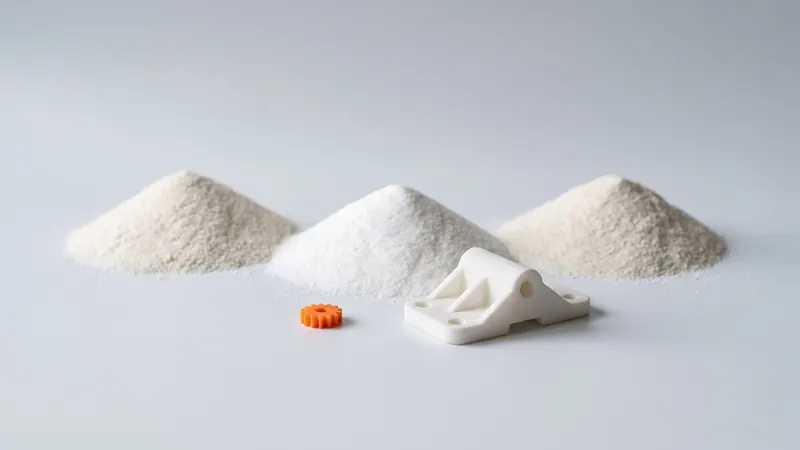
Nylon is not one material. PA6, PA66, PA11 and PA12 are all polyamides, but the number in the name changes how much water they absorb, how stiff and tough they are and how they can be processed. For 3D printing the choice is often made for you by the process. This guide compares the common nylons in plain terms, explains why selective laser sintering standardizes on PA 12, and helps you decide when PA 12 is the right material and when it is not.
What the numbers mean
Polyamides are named after the number of carbon atoms in their building blocks. In PA6 the repeating unit has six carbon atoms, in PA11 eleven, in PA12 twelve; PA66 is made of two building blocks with six carbon atoms each. The longer the chain between the amide groups, the fewer amide groups per unit of length. Amide groups attract water and make the polymer stiffer and more heat-resistant. That single difference explains most of the comparison below.
Comparison at a glance
| Property | PA6 / PA66 | PA11 | PA12 |
|---|---|---|---|
| Water absorption | High; properties change with humidity | Low | Low |
| Dimensional stability in humid air | Moderate | Good | Good |
| Stiffness and strength (dry) | High | Moderate | Moderate |
| Toughness, ductility | Good | Very good | Good |
| Melting point | Higher | Lower | Lower (EOS: 176 °C for PA 2200) |
| Chemical resistance | Good | Very good | Very good |
| Origin | Petrochemical | Castor oil (bio-based) | Petrochemical |
| Typical processes | Injection molding, machining, filament | Injection molding, powder-bed printing | Powder-bed printing (SLS, MJF), injection molding, tubes |
The table compares material families in general terms. Exact values depend on the grade, the process and the conditioning of the part; for design calculations use the datasheet of the specific material.
PA6 and PA66: stiff, strong, thirsty
PA6 and PA66 are the most common engineering nylons in injection molding and machining. Dry, they are stiffer and stronger than PA12 and handle higher temperatures. Their weakness is water: they absorb much more moisture, which makes them tougher but also softer, and changes their dimensions. A part designed for tight fits in PA6 behaves differently in a dry workshop and in a humid one. Glass-filled PA6 and PA66 are standard for structural molded parts.
PA11: the tough, bio-based alternative
PA11 is close to PA12 in most respects, but more ductile and more impact-resistant, and it is made from castor oil. It is a good choice for parts that are bent repeatedly or must survive impacts. In powder-bed printing it is used less often than PA12 and processes differently.
PA12: stable, resistant, the SLS standard
PA12 absorbs little water, keeps its dimensions and stiffness in humid air and resists oils, greases, fuels and many solvents. Its lower stiffness compared with PA6 is rarely a problem for printed parts, which are usually designed with ribs and even walls. For PA 2200, EOS gives a tensile strength of 48 MPa within the layers and 42 MPa across them, an elongation at break of 18 % and 4 %, and a melting point of 176 °C. The PA12 nylon guide explains the material in detail.
Why selective laser sintering standardizes on PA12
Laser sintering keeps the whole powder bed just below the melting point and lets the laser fuse only the cross-sections of the parts. That only works with a powder that has a wide window between the temperature at which it melts and the temperature at which it solidifies again: inside that window, the parts stay soft enough not to warp while the next layers are added. PA12 has such a window, flows well as a powder and can partly be reused. These processing properties, more than any single mechanical value, made it the default SLS material. More about the process in What is SLS 3D printing.
Which nylon for which part?
| Requirement | Good choice | Why |
|---|---|---|
| Complex functional part, prototype or small series, fast | PA12 (SLS) | No mold, no supports, stable dimensions |
| Fits that must stay stable in changing humidity | PA12 | Low water absorption |
| Repeated bending, impacts | PA11 or a design with less strain | Higher ductility |
| High stiffness at higher temperature, large series | PA6 / PA66, often glass-filled, molded | Stiffer, higher melting point |
| Contact with oils, fuels, greases | PA12 or PA11 | Very good chemical resistance |
| Prototype of a part that will later be molded in PA6 | PA12 (SLS) for shape and function tests | Fast; keep in mind that stiffness differs |
Prototyping in PA12 for a PA6 series part
A common case: the series part will be injection-molded in PA6 or PA66, the prototypes are printed in PA12. That works well for shape, fit and assembly. For stiffness, creep and behavior in humidity, remember that the materials differ: a PA12 prototype is somewhat softer than a dry PA6 part and much less sensitive to moisture. Snap-fits and clips designed for PA6 strain levels can behave differently in PA12; see snap-fit joints in SLS PA 12. When the series is coming, the guide SLS vs injection molding helps find the point where a mold pays off.
Moisture, conditioning and what it means for printed parts
Every polyamide takes up some water from the air until it reaches a balance with its surroundings. For PA6 and PA66 this changes stiffness, toughness and dimensions noticeably, which is why molded PA6 parts are often conditioned before they are measured or assembled. PA12 takes up much less water, so a printed part behaves almost the same in a dry hall and in a humid one. For printed fixtures, gauges and housings with fits, this stability is often worth more than the higher stiffness of PA6.
What we print
We print white PA 12, EOS PA 2200, on an EOS FORMIGA P 110 Velocis with a chamber of 200 × 250 × 330 mm in the Czech Republic. Every part is glass-bead blasted and polished in a DyeMansion Powershot DUAL, included in the price. Parts can be dyed in 61 colors: black and orange are in stock with the normal lead time, the other colors are priced instantly too and take about one month longer to deliver. For other materials, write to us; for material choice as part of a design, the specialists at prototype.builders can help.
Frequently asked questions
What is the difference between PA6 and PA12?
Both are polyamides. PA6 has more amide groups per chain length, so it is stiffer and has a higher melting point, but absorbs much more water and changes its dimensions and stiffness with humidity. PA12 absorbs much less water, keeps its dimensions better and resists more chemicals, at the price of lower stiffness.
Is PA11 better than PA12?
Neither is better in general. PA11 is more ductile and impact-resistant and is made from castor oil; PA12 is slightly stiffer and is the standard material of laser sintering. For parts that are bent repeatedly or take impacts, PA11 can be the better choice.
Why is PA12 used for SLS?
Laser sintering needs a powder with a wide window between melting and recrystallization temperature, so the powder bed can be kept hot without the parts warping. PA12 has such a window, flows well as a powder and can partly be reused, which made it the default SLS material.
Does PA12 absorb water?
Much less than PA6 or PA66. That is why PA12 parts keep their dimensions and stiffness in humid air better than parts made of the shorter-chain nylons.
Which nylon do you print?
We print white PA 12 (EOS PA 2200) on an EOS FORMIGA P 110 Velocis. For other materials, write to us; the calculator prices PA 12 parts instantly.
Is nylon 12 the same as PA 12?
Yes. PA12, PA 12, nylon 12 and polyamide 12 are names for the same polymer. Trade names of sintering powders differ by manufacturer.
Get an instant price
Upload STEP or STL files to the calculator and see the price of your parts in seconds: white Nylon PA 12, blasting and polishing included, optional dyeing in 61 colors, three delivery speeds. From there you send the order preview for confirmation.
Another material, an NDA or a large series? Write to us. For design help and prototype development see prototype.builders.
Get an instant price