
SLS vs Injection Molding: When Does 3D Printing Stop Being Cheaper?
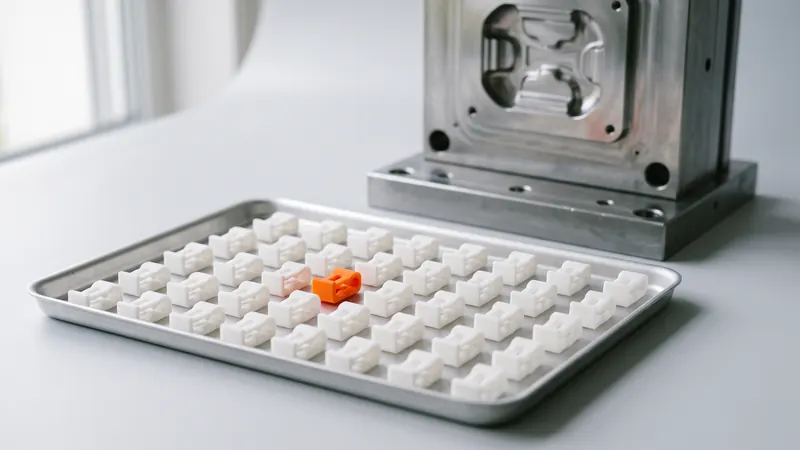
Injection molding is the cheapest way to make plastic parts in large numbers, and SLS 3D printing is often the cheapest way to make a few. Somewhere in between the lines cross. Where exactly depends on your part, not on a universal number. This guide shows how to find your break-even quantity, what else besides price decides, and how the two processes work together.
Two different cost structures
The two processes spend money in opposite ways.
- Injection molding needs a mold machined from steel or aluminum before the first part exists. The mold is a large one-off investment. After that, each part costs very little: a few seconds of machine time and the plastic.
- SLS needs no mold. Each part pays for its own material, its share of the print job and its finishing. The price per part is much higher than a molded part, but there is no up-front investment, and the price per part falls as more parts share a print job.
So the comparison is never "which process is cheaper", but "which is cheaper for this part at this quantity".
How to find the break-even quantity
You need three numbers, all specific to your part:
- T: the cost of the mold (quote from a mold maker)
- M: the price per molded part (quote from the molder)
- S: the price per SLS part at your quantity (the instant price from the calculator)
The break-even quantity is roughly N = T ÷ (S − M). Below N parts, SLS is cheaper in total; above N, molding is. Because S falls somewhat with quantity in SLS, check the SLS price at the quantity you actually expect, not at one piece.
The result can be surprising in both directions. A small, compact part with a simple mold can break even at a few hundred pieces. A complex part that needs a mold with slides, lifters or several cavities can stay cheaper in SLS for thousands of pieces, especially if the design will still change.
What pushes the break-even point up (in favor of SLS)
- Complex geometry. Undercuts, internal channels and lattices need mold slides or cannot be molded at all; in SLS they cost nothing extra.
- Small parts. Many small parts nest in one SLS print job, which keeps the price per part low.
- Design changes. Every change to a molded part means modifying or replacing the mold. In SLS, you upload a new file.
- Many variants. Ten versions of a part in twenty pieces each are ten molds, or one SLS print job.
- Uncertain demand. No capital is tied up in a mold for a product that may sell fewer units than planned.
What pulls it down (in favor of molding)
- Large, bulky parts. In SLS they occupy a lot of space in the print job; see SLS 3D printing cost for why size matters more than weight.
- Simple shapes. A part that a simple two-part mold can produce benefits fully from cheap cycle times.
- Stable, high volumes. Once demand is known and the design frozen, molding is hard to beat.
- Surface and material requirements. Glossy or textured surfaces, glass-filled or special grades and transparent parts point to molding.
Design rules are different
A part designed for molding can be printed, but not the other way around. Molding requires:
| Requirement | Injection molding | SLS |
|---|---|---|
| Draft angles on walls | Needed so the part releases from the mold | Not needed |
| Uniform wall thickness | Critical (sink marks, warping) | Recommended (shrinkage, warping) |
| Undercuts | Need slides or lifters | Free |
| Internal channels, lattices | Mostly impossible | Possible with powder escape |
| Part consolidation | Limited by mold opening | Several parts can become one |
| Gates, ejector marks, parting lines | Visible on the part | None |
If a part will eventually be molded, design it with draft and moldable features from the start and print the early versions in SLS. If the part will stay in small numbers, use the freedom of SLS: consolidate parts, add internal channels, skip the draft. The SLS design guidelines cover the rules that do apply.
Material: similar, not identical
Our SLS parts are made from PA 12 (EOS PA 2200), a nylon also used in molding. The properties of a sintered part are not the same as those of a molded one: for PA 2200, EOS gives a tensile strength of 48 MPa within the layer plane and 42 MPa across the layers, and an elongation at break of 18 % against 4 %. A molded nylon part is fully dense and usually more ductile. Use SLS parts to test fit, function and assembly; if the final product must pass tests in the molded material, test molded samples before the release.
Lead time
A production mold typically takes weeks to make and needs sampling and corrections before parts are approved. An SLS part is printed, finished and shipped in days; the calculator offers three delivery speeds. That time difference is often worth more than the price difference: a product on the market weeks earlier, or an assembly line that does not wait for a missing fixture.
Using both: bridge production
Many products use both processes in sequence:
- Prototypes: SLS parts for fit and function tests, several design iterations.
- Pilot series and market launch: SLS parts in tens to hundreds while the mold is made.
- Series: molded parts once the design is frozen and demand is proven.
- Spare parts and end of life: SLS again, when volumes drop and storing the mold costs more than printing.
The same approach works for fixtures and assembly aids used alongside molded products; see 3D-printed jigs and fixtures.
Checklist: is SLS right for this quantity?
- Get the SLS price at the real quantity from the calculator.
- Get a mold quote and a price per molded part.
- Compute N = T ÷ (S − M) and compare with your expected volume over the product life.
- Add the cost of design changes you still expect.
- Add the value of time to market.
- Check whether the design needs features only SLS can make.
- Check whether the final material and surface must be molded.
For the design side of the decision, including making a part moldable later, the specialists at prototype.builders can review your design intent. For the SLS side of the equation, upload the part to the instant SLS calculator and try a few quantities: the price per part updates immediately.
Frequently asked questions
When is 3D printing cheaper than injection molding?
When the quantity is below the break-even point: roughly the mold cost divided by the difference between the SLS price per part and the molded price per part. For complex or small parts and changing designs, that point can be hundreds or thousands of pieces.
How do I calculate the break-even between SLS and injection molding?
Divide the mold cost T by the difference between the SLS price per part S and the molded price per part M: N = T / (S - M). Use the SLS price at your real quantity, because it falls as more parts share a print job.
Can SLS be used for low-volume production?
Yes. SLS needs no tooling and nests many parts in one print job, so tens to hundreds of PA 12 parts are a typical use, including pilot series while a mold is being made.
Are SLS parts as strong as injection-molded parts?
Not exactly. Sintered PA 12 is strong and tough, but a molded nylon part is fully dense and usually more ductile. Use SLS parts for fit and function; test molded samples when the final material must be qualified.
Do SLS parts need draft angles?
No. There is no mold to release from, so draft angles, gates and ejector marks do not apply. If the part will be molded later, include draft from the start.
How fast are SLS parts compared with a new mold?
A production mold usually takes weeks plus sampling. SLS parts are printed, finished and shipped in days, with three delivery speeds in the calculator.
Get an instant price
Upload STEP or STL files to the calculator and see the price of your parts in seconds: white Nylon PA 12, blasting and polishing included, optional dyeing in 61 colors, three delivery speeds. From there you send the order preview for confirmation.
Another material, an NDA or a large series? Write to us. For design help and prototype development see prototype.builders.
Get an instant price