
How Much Does SLS 3D Printing Cost? What Drives the Price of a Nylon Part
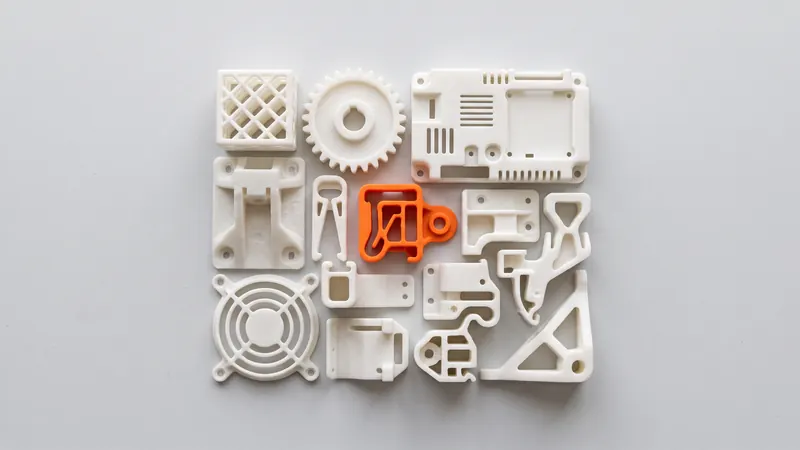
There is no flat price per gram in SLS 3D printing. The cost of a laser-sintered nylon part depends on how much material it turns into a solid part, how much of the printer's chamber it occupies and what happens to it after printing. Once you know these drivers, you can see which design changes make a part cheaper and which make no difference at all.
Why SLS is priced differently from other processes
In injection molding, most of the cost sits in the mold. In CNC machining, it sits in machine time and setup. SLS has neither: there is no tooling, no fixture and no support structure. Instead, parts from many orders share one print job. Our EOS FORMIGA P 110 Velocis has a chamber of 200 × 250 × 330 mm, and the machine fills it layer by layer with parts stacked in three dimensions.
A part therefore pays for its share of three things:
- The material it turns into a solid part, together with the powder around it that cannot be reused indefinitely.
- The space and height it takes up in the chamber, which no other part can use.
- The work after printing: unpacking, depowdering, blasting, polishing and, if chosen, dyeing.
The six drivers of SLS printing cost
| Driver | What it means | Effect on price |
|---|---|---|
| Part volume | The amount of sintered PA 12 in the part | Direct: more material, higher price |
| Bounding box | The space the part blocks in the chamber, including the air inside it | Strong for bulky, open or hollow shapes |
| Part height | How many layers the part spans | Moderate: tall, thin parts cost more than flat ones |
| Order volume | The total volume of all parts in one order | Larger orders get a volume discount on printing |
| Dyeing | Blasting and polishing are included; dyeing is an extra step | Adds a step and a small price per part volume |
| Delivery level | Express, Standard or Economy | Faster delivery costs more |
1. Part volume
The more nylon is fused, the more material and laser time a part consumes. A solid block costs more than a shelled version of the same shape. Volume is the easiest driver to reduce, because most parts designed for machining or molding are thicker than a printed part needs to be.
2. Bounding box and packing
A thin-walled box 150 mm on a side contains little material, but it occupies a large part of the chamber. Parts that nest well, such as flat brackets or compact shapes, leave room for other parts. Bulky, open shapes with large empty interiors are the opposite, so for them the space they block, not their material, sets the price.
3. Part height
SLS builds layer by layer, typically around a tenth of a millimeter per layer. A tall part adds layers to the print job, and every layer takes time whether the rest of it is full or empty. Orientation in the printer is chosen during print preparation, balancing height, surface and accuracy, so you do not have to specify it.
4. Order volume and quantity
Because no mold is involved, the price of each part is roughly proportional to the space and material it needs, so ten parts cost about ten times one part. What lowers the price per part is a larger order: above a certain total volume of parts in one order, a volume discount on printing applies and grows with the order. That is why ordering your real demand at once is cheaper than several small orders.
5. Finishing and color
Every part we print is depowdered, then blasted and polished in a DyeMansion Powershot DUAL. Both steps are included in the price. Dyeing is a separate step: all 61 colors of our color catalog are priced instantly. Our parts come out of the printer bright white, which is why dyed colors look true to the chart; the article MJF vs SLS explains the difference a white base makes.
6. Delivery level
You choose between Express, Standard and Economy. A longer lead time lets a part wait for the most efficient print job, which is reflected in the price. If your project allows it, Economy is the simplest way to save without touching the design.
What does not make an SLS part more expensive
- Complexity. Undercuts, internal channels, lattices and organic shapes need no supports and no tooling.
- Part consolidation. Combining an assembly of several parts into one printed part usually lowers the total cost.
- Variety. Every print job mixes parts from many orders, so several different designs in one order carry no penalty.
Nine ways to reduce the cost of an SLS part
- Hollow thick sections. Shell solid volumes and add escape holes so the powder can be removed. The right wall thickness depends on the loads on the part.
- Give closed cavities escape holes. Powder trapped inside a closed void stays in the part and cannot be removed. The calculator detects enclosed cavities and prices them as solid, with a design review note.
- Use ribs instead of solid thickness. A rib pattern gives stiffness with a fraction of the volume.
- Design compact shapes. If a part can be folded, split or flattened without losing its function, it nests better.
- Split very large parts. A part that only fits the chamber diagonally may be cheaper as two parts joined with a dovetail, snap-fit or screws.
- Consolidate assemblies. Replace screwed sub-assemblies with one printed part where you can, including print-in-place hinges.
- Order the quantity you really need. One order of 30 parts reaches a higher volume discount than three orders of 10.
- Dye only where color matters. White parts skip the dyeing step.
- Choose the slowest delivery you can accept. Economy costs less than Express.
How hollow a part can be, how thin its walls and ribs may get and where inserts make sense depends on the application and the loads. If you are not sure, the specialists at prototype.builders can review the design intent with you.
How to get a price in practice
Traditional suppliers ask you to send a request and wait for a quote, which makes it slow to compare design variants. An instant price lets you treat cost as a design input:
- Export your part as STEP or STL.
- Upload it to the SLS 3D printing cost calculator. The 3D viewer shows the part, the calculator splits multi-body files into parts and flags enclosed cavities.
- Read the design review notes, choose quantity, color and delivery level and see the price immediately.
- Change the design, upload it again and compare.
Dimensions matter too: the guide to SLS tolerances and clearances shows how to design fits that work the first time, so you do not pay for a second iteration. For one of the most cost-effective uses of SLS, see 3D-printed drill templates, jigs and fixtures.
Checklist before you upload
- The part fits 200 × 250 × 330 mm, or is split into sections that do.
- No solid sections thicker than the function needs.
- Every closed cavity has escape holes.
- Quantity matches your real demand.
- Color chosen only where needed.
- Delivery level matches your real deadline.
Frequently asked questions
How much does SLS 3D printing cost per part?
It depends on the volume of the part, the space it occupies in the chamber, its height, the total volume of the order, the color and the delivery level. A small bracket and a large housing can differ in price by an order of magnitude. The quickest way to get an exact figure is to upload the STEP or STL file to the instant calculator.
Is SLS more expensive than FDM printing?
For a single simple part, filament printing is often cheaper. SLS becomes competitive for complex parts, functional parts that must be strong in every direction and batches of parts, because it needs no supports and many parts share one print job.
Does a more complex design cost more in SLS?
Usually not. SLS needs no support structures or tooling, so undercuts, internal channels and organic shapes add little or nothing to the price. Volume and size matter far more than complexity.
Why is the price per part lower for larger orders?
Above a certain total volume of parts in one order, a volume discount on printing applies, and it grows with the order. Ordering your real demand at once is therefore cheaper than several small orders.
Is post-processing included in the price?
Yes. Depowdering, blasting and polishing are included. Dyeing is a separate, optional step, priced instantly in any of 61 colors.
How can I make an SLS part cheaper?
Hollow thick sections and add escape holes, replace solid thickness with ribs, make the shape compact, consolidate assemblies, order your real quantity at once, keep parts white where color is not needed and choose a slower delivery level.
Get an instant price
Upload STEP or STL files to the calculator and see the price of your parts in seconds: white Nylon PA 12, blasting and polishing included, optional dyeing in 61 colors, three delivery speeds. From there you send the order preview for confirmation.
Another material, an NDA or a large series? Write to us. For design help and prototype development see prototype.builders.
Get an instant price