
SLS Tolerances and Clearances: How Accurate Are Laser-Sintered PA 12 Parts?
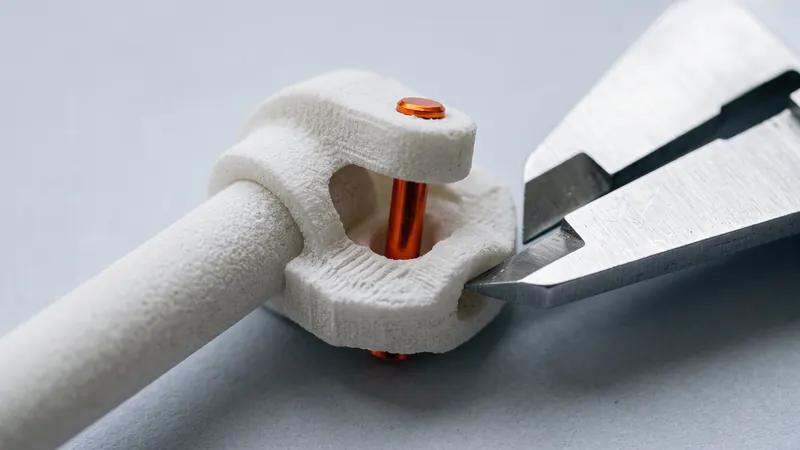
SLS produces strong nylon parts without supports, which makes it a natural choice for functional prototypes, fixtures and small series. The next question is always the same: how accurate is it, and what gap do two parts need to fit together? This guide gives realistic figures for laser-sintered PA 12, explains where deviations come from and lists practical clearances.
The short answer
For laser-sintered PA 12 the general tolerance we design to is ±0.3 % of the nominal dimension, with a lower limit of ±0.3 mm. This is the usual guideline for the process, not a guarantee for every geometry. EOS, the maker of our FORMIGA P 110 Velocis and of the PA 2200 family of PA 12 powders, does not publish a single tolerance figure: its datasheets give material and process data and point out that part properties depend on geometry, orientation and processing.
| Nominal dimension | General tolerance |
|---|---|
| 10 mm | ±0.3 mm (lower limit applies) |
| 50 mm | ±0.3 mm (lower limit applies) |
| 100 mm | ±0.3 mm |
| 200 mm | ±0.6 mm |
| 300 mm | ±0.9 mm |
A compact part with even walls is often better than the guideline. A thick, flat or very long part can deviate more.
Where dimensional deviations come from
Shrinkage during cooling
Sintered PA 12 shrinks as it cools down from close to its melting point, which EOS gives as 176 °C for PA 2200. Print preparation compensates for the average shrinkage by scaling the part, but shrinkage is not perfectly uniform: thick sections hold heat longer and shrink more than thin walls next to them. That is why parts with even wall thickness are the most accurate.
Warping of large flat areas
Large, thin, flat plates cool unevenly and can bow. Ribs, a slight curvature or a flange along the edge make plates much more stable. If flatness matters, a rib pattern on the back is cheaper than any rework.
Powder adhesion
Powder grains next to the fused outline partly melt and stick to the surface. This gives SLS its matte, slightly grainy texture and has two effects on dimensions: holes and slots come out slightly smaller than designed, and pins and bosses slightly larger. The effect is most visible on small holes, which can fill with partly sintered powder.
Orientation in the printer
Layers are about a tenth of a millimeter thick (EOS lists 0.12 mm for the PA 2200 Balance process). Gently sloped surfaces show fine layer steps, and properties differ between the layer plane and the vertical direction: EOS gives a tensile strength of 48 MPa within the layers and 42 MPa across them for PA 2200, and an elongation at break of 18 % against 4 %. Print preparation chooses the orientation for the whole print job; if one face or bore is critical, design it so that it does not depend on orientation, or ask before you order.
Finishing and dyeing
Our parts are blasted and polished in a DyeMansion Powershot DUAL. Blasting removes loose and loosely adhering powder; according to DyeMansion, its PolyShot Surfacing compacts the surface rather than removing material, so the original geometry is retained. In our experience the change is in the range of hundredths of a millimeter, well inside the print tolerance; sharp edges are rounded slightly. Dyeing with TCN liquid dyes colors the surface layer: the dye penetrates into the nylon instead of forming a coating, so it adds no layer of material.
Recommended clearances for fits
The values below are common starting points for laser-sintered PA 12, not guarantees. For a critical fit, print a small test piece first; with an instant price, a test coupon costs little.
| Fit | Starting clearance | Notes |
|---|---|---|
| Moving parts printed in place (hinges, chains) | at least 0.5 mm gap | Smaller gaps risk fusing; the powder must be able to escape |
| Sliding fit between two printed parts | about 0.3 to 0.5 mm in total | Start at 0.4 mm and adjust after a test print |
| Snug locating fit between two printed parts | about 0.2 to 0.3 mm in total | Needs light force; depends on feature size |
| Hole for a metal pin or shaft | Design to nominal, ream to size | Reaming a printed hole gives a clean, accurate bore |
| Press fit of a metal part | Slightly undersized, then test | Nylon creeps under constant load |
"In total" means the difference between hole and pin diameter, so about half of it on each side.
Print-in-place assemblies
Because SLS needs no supports, hinges, ball joints and chains can be printed already assembled. Two things matter: a gap of at least 0.5 mm and a way for the powder to get out. Closed pockets trap powder; the calculator detects enclosed cavities when you upload the model.
Holes, threads and inserts
Printed holes are fine for clearance screws. For accurate bores, design the hole to nominal size or slightly undersized and finish it by drilling or reaming; PA 12 machines cleanly. Whether a thread should be printed, tapped or carried by a metal insert, and how much material it needs around it, depends on the size, the loads and how often the screw is tightened. These choices are best made with the design intent on the table: the specialists at prototype.builders can review them with you.
How to design for accuracy
- Keep wall thickness as uniform as possible; avoid thick lumps next to thin walls.
- Hollow or rib thick sections to reduce shrinkage.
- Add ribs or curvature to large flat plates.
- Use at least 0.5 mm gaps for print-in-place moving parts.
- Use about 0.3 to 0.5 mm total clearance for sliding fits between separate parts.
- Plan to ream bores that need an accurate diameter.
- Print a test coupon for critical fits.
- Remember that the general tolerance grows with size: ±0.6 mm at 200 mm.
When SLS tolerances are not enough
SLS is accurate enough for most housings, brackets, clips, functional prototypes and drill templates, jigs and fixtures. It is not the right process when many features must hold hundredths of a millimeter, for sealing faces that must be perfectly flat, or for bearing seats without post-machining. The common solution is a hybrid: print the complex body in SLS and machine the few critical features afterwards. More about the material is in the PA12 nylon guide, and about the process in What is SLS 3D printing.
To see what your part costs, upload it to the instant SLS calculator; the guide to SLS 3D printing cost explains what drives the price.
Frequently asked questions
What tolerance can SLS 3D printing achieve?
The general tolerance for laser-sintered PA 12 is ±0.3 % of the dimension, with a lower limit of ±0.3 mm. A 100 mm feature is typically within ±0.3 mm and a 200 mm feature within ±0.6 mm. Thick or flat parts can deviate more.
Is SLS more accurate than FDM?
For functional nylon parts, generally yes. SLS needs no supports, uses fine layers and compensates shrinkage during print preparation. A well-tuned filament printer can be accurate on small parts, but SLS is more consistent on complex geometry.
What clearance should I use for moving parts printed in place?
Use a gap of at least 0.5 mm between moving surfaces, and make sure the loose powder can escape from the joint after printing.
Why are holes in SLS parts smaller than designed?
Powder next to the fused outline partly melts and sticks to the wall, so holes shrink slightly and pins grow slightly. For accurate bores, design to nominal size and ream after printing.
Does blasting, polishing or dyeing change the dimensions?
Only marginally. According to DyeMansion, PolyShot Surfacing compacts the surface without removing material; in our experience the change is in the range of hundredths of a millimeter. Dyeing colors the surface layer without adding a coating.
Can SLS parts be press-fitted?
Press fits between two printed nylon parts are unreliable because nylon creeps under constant load. For metal pins or bushings, design the hole slightly undersized, test the fit and consider reaming or inserts.
Get an instant price
Upload STEP or STL files to the calculator and see the price of your parts in seconds: white Nylon PA 12, blasting and polishing included, optional dyeing in 61 colors, three delivery speeds. From there you send the order preview for confirmation.
Another material, an NDA or a large series? Write to us. For design help and prototype development see prototype.builders.
Get an instant price