
Dyeing SLS Parts: How Color Works on Nylon PA 12
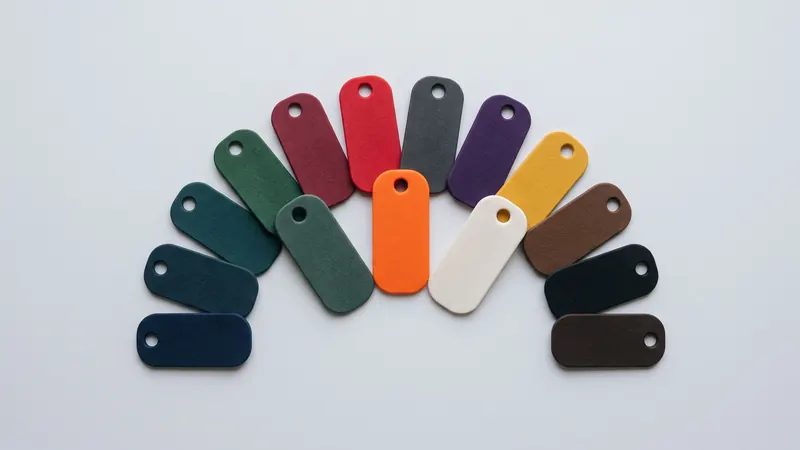
Laser-sintered PA 12 comes out of the printer white. That white base is an advantage: nylon takes liquid dyes well, and on a white part colors look clean and saturated. This guide explains how dyeing works on SLS parts, which colors are available, what affects the final shade, and how to design and order colored parts.
How dyeing works on SLS nylon
A laser-sintered part has a slightly porous, fine-grained surface. In a hot dye bath, the liquid dye diffuses into the polyamide and stays there. Instead of a layer on top, as with paint, the color sits in the outer layer of the material. According to DyeMansion, the dye penetrates about 0.2 mm into PA 2200, the PA 12 powder we print.
- No added thickness: fits, threads and gaps stay as designed.
- No flaking: there is no coating that could chip off.
- Surface stays as it is: the satin feel of the blasted and polished part is kept.
- Machining after dyeing cuts below the colored layer and exposes white nylon. Ream or drill before dyeing if those surfaces should be colored too.
The order of steps
- Printing in white PA 12 on our EOS FORMIGA P 110 Velocis.
- Depowdering, then glass-bead blasting and polishing in a DyeMansion Powershot DUAL (always, included in the price).
- Dyeing with TCN liquid dyes, as a separate step, only for parts ordered in color.
More about the steps in SLS post-processing and surface finish.
Why the white base matters
Think of printing on paper: the same ink looks bright on white paper and dull on gray paper. SLS parts are white, so a dye shows its true shade, and light and saturated colors such as yellow, orange, light blue or pink are possible. Parts from HP Multi Jet Fusion are gray because of the fusing agent used in that process; on that base, dyeing is in practice limited to darker shades, most often black. If color matters, decide on the process before you finalize the design. The comparison is in MJF vs SLS.
Available colors
Our color catalog shows 61 colors from the liquid-dye charts of TCN, with their original codes and names: 29 colors of the GTC chart, 20 of the GTD chart and 12 RAL-matched examples that the dye maker shows as colors made to order. You can filter them by chart and color family.
| Option | Colors | How to order |
|---|---|---|
| Not dyed | Natural white | Choose in the calculator, instant price |
| Dyed, in stock | Black (GTD 8485) and orange (GTD 8645) | Choose in the calculator, instant price, normal lead time |
| Dyed, all other colors | The remaining 59 shades of the catalog | Choose in the calculator, instant price, delivery about one month longer |
The swatches in the catalog are screen approximations taken from the dye maker's printed chart, not measurements of dyed parts. Every screen shows color differently. If the exact shade matters, ask for a physical sample before you decide.
What affects the final shade
| Factor | Effect | What you can do |
|---|---|---|
| Dye batch | Parts dyed together match very closely; small differences between batches are possible | Order parts that must match in one order |
| Wall thickness and geometry | Thin walls and edges can look slightly lighter or darker than thick areas | Keep visible walls even; judge color on the real part |
| Surface | The satin, slightly grainy surface makes colors look matte, not glossy | Expect a matte technical look |
| Light shades | Pastel and fluorescent tones are harder to match exactly; a screen cannot show fluorescence | Ask for a sample |
| Machining after dyeing | Exposes white nylon under the colored layer | Machine before dyeing |
| Long sunlight exposure | Dyed and natural parts can change over time outdoors | Test for permanent outdoor use |
Black for technical parts
Black is a common choice for technical parts: it hides handling marks, looks like a molded part in an assembly and suits jigs, fixtures, housings and visible machine parts. Black and orange are the two dyes we keep in stock.
Color as a function
- Color coding: left and right versions, sizes, variants or tools for different products, easy to tell apart on the shop floor.
- Safety and attention: orange grips and handles on jigs and fixtures.
- Branding: parts in a product color for prototypes, trade-show models and small series.
- Assembly aid: mating parts in different colors make the right orientation obvious.
Design tips for dyed parts
- Open cavities and channels so the dye can reach them, as for powder removal.
- Keep visible walls of similar thickness for an even shade.
- Ream or drill critical bores before dyeing if their surfaces should be colored.
- Do not count on dyeing to hide layer steps; dyeing colors the surface without smoothing it.
- Order parts that must match in color together.
How to order colored parts
- Choose the color in the calculator: upload your STEP or STL files, choose natural white or any of the 61 colors and see the price instantly after a free sign-in. The price includes printing, blasting, polishing and dyeing.
- Find the shade first: browse the color catalog by chart, color family, code or name.
- Exact match needed: ask for a physical sample first, then order all parts that must match in one order.
All parts are printed and dyed in the EU, in the Czech Republic.
Does color cost more?
Dyeing is an additional step and is priced as such. The calculator shows the price including dyeing instantly for every color. The guide to SLS 3D printing cost explains the other price drivers. If color is part of a product design, the specialists at prototype.builders can help with the design and prototypes.
Frequently asked questions
Can SLS nylon parts be dyed?
Yes. PA 12 absorbs liquid dyes well. The parts are dyed after blasting and polishing, and the dye penetrates into the surface layer instead of forming a coating.
How deep does the color penetrate into SLS parts?
According to DyeMansion, dye penetrates about 0.2 mm into PA 2200. The color is in the material, so it adds no thickness and cannot flake off like paint.
Which colors can I order?
All 61 colors of our color catalog, from the liquid-dye charts of the dye maker TCN. Every color can be chosen in the calculator and is priced instantly. Black and orange are in stock and have the normal lead time; the other 59 colors take about one month longer to deliver.
Why do colors look better on SLS than on MJF parts?
SLS parts are white, MJF parts are gray because of the fusing agent. Like printing on white versus gray paper, a white base gives truer, lighter and more saturated colors, while a gray base is in practice limited to dark shades.
Will all dyed parts have exactly the same shade?
Parts dyed together in one batch are very consistent. Between batches and between parts of very different geometry, small differences are possible. If the exact shade matters, ask for a physical sample and order matching parts together.
Does dyeing change the dimensions?
No measurable layer is added, because the dye penetrates the material instead of coating it. Dyeing does not affect fits designed for the general tolerance.
Get an instant price
Upload STEP or STL files to the calculator and see the price of your parts in seconds: white Nylon PA 12, blasting and polishing included, optional dyeing in 61 colors, three delivery speeds. From there you send the order preview for confirmation.
Another material, an NDA or a large series? Write to us. For design help and prototype development see prototype.builders.
Get an instant price