
SLS Post-Processing and Surface Finish: Depowdering, Blasting, Polishing, Dyeing
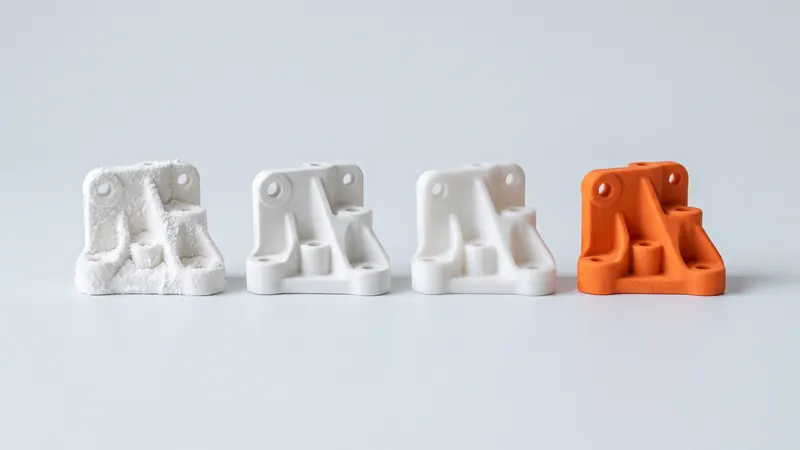
A part that comes out of an SLS printer is not finished yet. It sits in a block of loose powder, its surface is covered with partly fused grains and it is rough to the touch. Post-processing turns it into a clean, even part ready for assembly. This guide explains each step we apply to laser-sintered PA 12, what the surface looks and feels like after it, and which finishes we do not offer.
Overview: what happens after printing
| Step | What it does | At SLS Market |
|---|---|---|
| 1. Cooling | The print job cools slowly in the powder to limit warping | Always |
| 2. Unpacking and depowdering | Parts are taken out of the powder cake and cleaned of loose powder | Always, included |
| 3. Glass-bead blasting | Removes adhering powder from surfaces, holes and gaps | Always, included |
| 4. Polishing | Makes the surface even and satin | Always, included |
| 5. Dyeing | Colors the parts through the surface layer | Optional: 61 colors, all with an instant price |
1. Cooling
When the last layer is printed, the parts are still embedded in hot powder. Nylon shrinks as it cools, and cooling too fast or unevenly causes warping. The whole print job therefore cools down slowly in the powder before it is unpacked. This is part of the process, not an option, and one reason why SLS lead times include more than printing.
2. Unpacking and depowdering
The parts are taken out of the block of powder (the "cake") and the loose powder is removed. In SLS, unfused powder in good condition is typically sieved and mixed with fresh powder for later print jobs. Internal channels and closed cavities are the critical spots: loose powder can only be removed if it has a way out. The calculator detects enclosed cavities when you upload a model, so you can add escape holes before you order.
3 and 4. Glass-bead blasting and polishing
We finish every part in a DyeMansion Powershot DUAL, and this step is included in the price. The machine works automatically in two stages:
- Blasting with glass beads removes the powder that still adheres to the surfaces, holes and gaps. The result is a clean, matte, even surface.
- Polishing compacts the surface. According to DyeMansion, this does not remove material, so the original geometry is retained. The surface becomes satin and smoother to the touch.
Automated blasting treats all parts of a print job the same way, so a series of parts has a consistent surface. Edges are rounded very slightly; in our experience the dimensional change is in the range of hundredths of a millimeter, well inside the print tolerance (see SLS tolerances and clearances).
5. Dyeing
Laser-sintered PA 12 is white, which makes it a good base for color. We dye parts with liquid dyes from the dye maker TCN. The dye penetrates into the nylon instead of forming a coating: according to DyeMansion, about 0.2 mm into PA 2200. The color therefore adds no thickness and cannot flake off like a coating. All 61 colors of our color catalog can be chosen in the calculator and are priced instantly; black and orange are in stock. The guide Dyeing SLS parts explains color choice and consistency.
Surface finishes compared
| Finish | Look and feel | Typical use | Offered |
|---|---|---|---|
| Raw (only depowdered) | Rough, powdery, white-gray dust on the surface | Not delivered as a finished part | No, every part is blasted and polished |
| Blasted and polished | Clean, even, satin white; fine grain visible | Functional parts, housings, fixtures, prototypes | Yes, standard and included |
| Blasted, polished and dyed | Same surface, colored through the surface layer | Visible parts, color coding, black technical parts | Yes, optional |
| Vapor smoothing | Sealed, smoother, slight gloss | Parts that must be easy to clean or look molded | No |
| Painting or coating | Any color and gloss level, adds a layer | Exact color matches, special appearance | No |
Why we do not vapor-smooth
Vapor smoothing seals the surface with a solvent-based process. It produces a smoother, slightly glossy surface, but it is an additional chemical step with its own effect on the part. Our standard is a mechanical finish (blasting and polishing) that keeps the geometry and suits functional parts, plus optional dyeing. If your application needs a sealed or glossy surface, tell us about it before you order, and we will tell you honestly whether SLS with our finish is the right fit.
What the finish means for your design
- Powder escape: every cavity and channel needs an opening; blasting cannot clean a closed pocket.
- Tiny features: very thin pins, ribs and lettering must withstand depowdering and blasting. Very fine details may be rounded.
- Gaps for moving parts: at least 0.5 mm, so blasting can clear them. See print-in-place hinges.
- Critical bores: design to nominal and ream after printing; ream before dyeing if the bore should be colored too.
- Color decisions: white SLS takes light and saturated colors; the white base gives truer colors than a gray one, as shown in MJF vs SLS.
What to expect on delivery
| You will see | Why |
|---|---|
| Satin, matte white surface with a fine grain | Typical of laser-sintered nylon after blasting and polishing |
| Fine layer steps on gently sloped surfaces | Layers of about 0.12 mm (EOS, PA 2200 process); polishing softens but does not remove them |
| Slightly rounded sharp edges | Effect of blasting and polishing |
| Small differences in surface between top and side faces | Orientation of the faces in the print job |
| Traces of powder deep in long, narrow channels | Hard to reach; open channels at both ends and keep them short |
| Even color on dyed parts, matte rather than glossy | The dye sits in the surface layer, the surface texture stays |
If a moving mechanism feels stiff at first, move it through its range a few times: fine powder residue in the gaps is released quickly.
Is finishing included in the price?
Yes. Depowdering, glass-bead blasting and polishing are part of every order and included in the price shown in the calculator. Dyeing in any of the 61 colors is selected in the calculator and priced instantly. The SLS 3D printing cost guide lists what drives the price. More about the finishing equipment is in the finishing section of our homepage.
Frequently asked questions
What is post-processing in SLS 3D printing?
The steps after printing: the parts are cooled and removed from the powder, cleaned of loose powder, blasted and polished, and optionally dyed. At SLS Market depowdering, glass-bead blasting and polishing are included in the price of every part.
Does blasting change the dimensions of SLS parts?
Only marginally. According to DyeMansion, the blasting and polishing process compacts the surface without removing material, so the geometry is retained. Sharp edges are rounded slightly.
Is a polished SLS surface smooth like a molded part?
No. Polishing makes the surface even and satin and removes the rough, powdery feel, but the fine grain of laser-sintered nylon stays visible. For a glossy, sealed surface, other finishing methods would be needed.
Do you offer vapor smoothing?
No. We offer depowdering, glass-bead blasting and polishing in a DyeMansion Powershot DUAL, and optional dyeing with TCN liquid dyes. We do not offer vapor smoothing, painting or coating.
How deep does the dye penetrate?
According to DyeMansion, dye penetrates about 0.2 mm into PA 2200. The color is in the material, not a layer on top, so it adds no thickness and cannot flake off like a coating.
Can SLS parts be painted?
Laser-sintered PA 12 can be painted after suitable preparation, but we do not offer painting. Our parts are delivered natural white or dyed.
Get an instant price
Upload STEP or STL files to the calculator and see the price of your parts in seconds: white Nylon PA 12, blasting and polishing included, optional dyeing in 61 colors, three delivery speeds. From there you send the order preview for confirmation.
Another material, an NDA or a large series? Write to us. For design help and prototype development see prototype.builders.
Get an instant price