
3D-Printed Drone Parts: Light, Tough Mounts and Frames in SLS Nylon
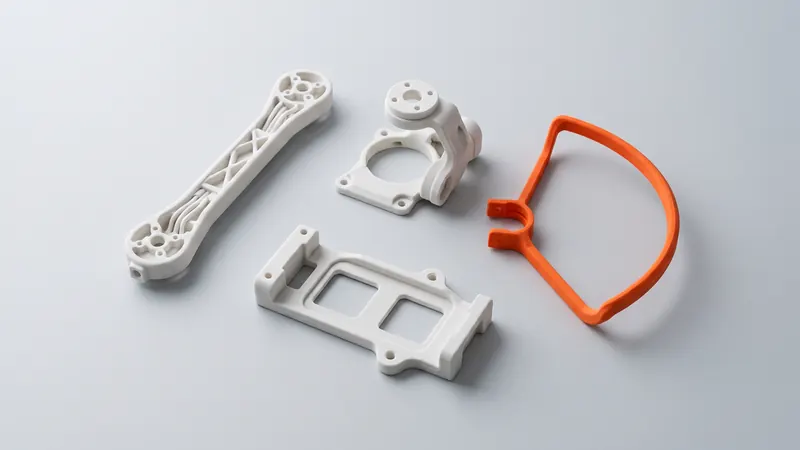
Drone builders need parts that are light, survive hard landings and arrive quickly in small numbers: camera and GPS mounts, arm clamps, landing gear, propeller guards, battery trays and housings for electronics. Laser-sintered PA 12 fits that list well. This guide explains what SLS nylon does well on a drone, where its limits are, and how to design printed drone parts that keep flying.
Why SLS nylon suits drone parts
- Light: EOS gives a density of 0.93 g/cm³ for parts made from PA 2200, the powder we print. That is lighter than water and about a third of the density of aluminum.
- Tough rather than brittle: EOS gives an elongation at break of 18 % within the layers. A nylon mount tends to bend before it cracks, which helps in a hard landing.
- No supports: cable channels, internal ribs, clips and undercuts print without support structures, so one part can replace several.
- Small series and variants: no mold, so a mount for a different camera or a modified arm clamp is simply another file in the same order.
- Color: every part is glass-bead blasted and polished; black and orange are in stock, and orange guards and skids are easy to see in grass.
Typical printed drone parts
| Part | Why SLS works | Watch out for |
|---|---|---|
| Camera and gimbal mounts | Exact fit to the camera, integrated cable guides | Vibration; isolate with separate rubber dampers |
| GPS, antenna and sensor mounts | Light masts and brackets in any geometry | Long thin masts flex; add ribs or a larger section |
| Arm clamps and motor mounts | Complex shapes, inserts for screws | Clamping force, motor heat, creep under constant load |
| Landing gear and skids | Tough, cheap to replace | Notches and sharp corners where impacts concentrate |
| Propeller guards | Large, light, one piece up to the chamber size | Thin rings break; give them height instead of thickness |
| Battery trays and strap holders | Snap-fits and slots for straps | Battery heat; keep loaded features away from it |
| Housings and canopies for electronics | Ventilation slots, bosses, cable entries | Not automatically waterproof |
Weight: design light, not just thin
Weight on a drone costs flight time, but the lightest part is rarely the one with the thinnest walls. Thin walls are fragile during handling and in a crash. Better ways to save mass:
- Ribs instead of solid sections. A thin plate with ribs is stiffer per gram than a thick flat plate.
- Hollow thick sections. A closed cavity must be able to release the powder: the calculator expects at least two escape holes of at least 5 mm per closed cavity. See hollow parts and escape holes.
- Keep walls above about 0.8 mm. The calculator warns about walls below roughly 0.8 mm; walls of about 1.5 to 3 mm give robust parts.
- Remove material where the load does not go. Openings and pockets in low-stress areas cost nothing to print.
The general rules are in the SLS design guidelines.
Crashes, notches and printing direction
The values EOS publishes for PA 2200 show where printed nylon breaks. Unnotched, EOS gives a Charpy impact strength of 53 kJ/m²; with a notch, 4.8 kJ/m². A sharp inner corner or a small notch therefore takes away most of the impact resistance. Round every inside corner, especially where an arm meets the center plate, where a skid meets the body and around screw holes.
Direction matters too. EOS gives an elongation at break of 18 % within the layers and 4 % across them, and a tensile strength of 48 MPa and 42 MPa. Parts that bend in a crash, such as skids, guards and arms, are best oriented so the bending strain lies within the layers. More in how strong SLS nylon is.
Plan for damage: skids and guards are wear parts. Designing them as separate, bolted pieces makes them cheap to replace, and a spare set can be ordered with the first print job.
Vibration, screws and inserts
Motors and propellers make the whole airframe vibrate, and vibration loosens screws in plastic. Practical rules:
- Use metal heat-set or press-in inserts for screws that hold motors, arms or batteries, or that are opened often.
- Give screw heads and nuts a large bearing surface or a washer, so the clamping force is spread over the nylon.
- Nylon slowly creeps under constant clamping force, more when it is warm. Check clamped joints after the first flights.
- PA 12 is fairly stiff and does not isolate vibration by itself. For cameras, use separate rubber or silicone dampers between the mount and the frame.
Heat from motors, controllers and batteries
Motors, speed controllers and batteries get warm, and PA 12 softens as temperature rises. For PA 2200, EOS gives a heat deflection temperature of 64 °C at 1.80 MPa (57 °C across the layers) and 157 °C at 0.45 MPa, and a melting point of 176 °C. Keep loaded features such as motor mounts and clamps away from hot spots, leave air around motors and controllers, and avoid parts that press directly on a warm battery.
Outdoors: sun and humidity
PA 12 absorbs little water compared with other nylons, so printed parts keep their dimensions in humid air. Untreated white PA 12 can yellow and become more brittle after long outdoor exposure. For a drone that lives outdoors, dyed parts (black is common) and an occasional check of guards and skids are sensible. Printed housings are not automatically waterproof: sintered PA 12 has a slightly porous surface, and sealing depends on the design and gaskets. We do not certify IP ratings.
Size: what fits in one piece
Our EOS FORMIGA P 110 Velocis has a chamber of 200 × 250 × 330 mm. Mounts, clamps, guards and the frames of small drones fit in one piece. Larger frames are split into a center section and arms that are bolted together, which also makes a broken arm easy to replace. The calculator checks the fit when you upload the model.
Where carbon fiber or aluminum is the better choice
EOS gives a tensile modulus of 1,650 MPa for PA 2200, far below carbon-fiber plate or aluminum. For racing frames and long, stiff arms, carbon-fiber plates usually remain the better choice. SLS nylon shines around them: mounts, clamps, guards, housings, adapters, landing gear and prototypes of new layouts, where shape freedom and toughness matter more than maximum stiffness.
Checklist for printed drone parts
- Inside corners rounded, no sharp notches in load paths.
- Bending parts oriented so the strain lies within the layers.
- Walls above about 0.8 mm, ribs instead of solid sections.
- At least two escape holes of at least 5 mm per closed cavity.
- Metal inserts for screws under vibration or opened often.
- Loaded features away from motors, controllers and batteries.
- Wear parts (skids, guards) as separate, replaceable pieces.
- Fits the 200 × 250 × 330 mm chamber, or split into parts.
For a complete airframe or a payload system that has to be engineered and tested, the specialists at prototype.builders can help with the design and the prototypes.
Frequently asked questions
Is SLS nylon good for drone parts?
Yes, for mounts, clamps, guards, landing gear, battery trays and housings. PA 12 is light (EOS gives 0.93 g/cm³ for PA 2200), tough and needs no support structures. For long, stiff arms and racing frames, carbon-fiber plate is usually stiffer.
Can I 3D print a whole drone frame in SLS?
Small frames fit in one piece in our 200 × 250 × 330 mm chamber. Larger frames are split into a center section and arms that are bolted together, which also makes a damaged arm easy to replace.
How do I make printed drone parts survive crashes?
Round all inside corners, avoid notches in load paths, orient bending parts so the strain lies within the layers, and design skids and guards as separate, replaceable parts.
Do screws stay tight in printed nylon under vibration?
Screws into plain printed holes can loosen under vibration. For motors, arms and batteries, use metal heat-set or press-in inserts, large bearing surfaces or washers, and check clamped joints after the first flights.
How hot can printed drone parts get?
EOS gives a heat deflection temperature of 64 °C at 1.80 MPa and 157 °C at 0.45 MPa for PA 2200, and a melting point of 176 °C. Keep loaded features away from motors, controllers and batteries.
Which colors are available for drone parts?
Black and orange are in stock with the normal lead time. All 61 colors can be chosen in the calculator with an instant price; the colors that are not in stock take about one month longer to deliver.
Get an instant price
Upload STEP or STL files to the calculator and see the price of your parts in seconds: white Nylon PA 12, blasting and polishing included, optional dyeing in 61 colors, three delivery speeds. From there you send the order preview for confirmation.
Another material, an NDA or a large series? Write to us. For design help and prototype development see prototype.builders.
Get an instant price