
Living Hinges in SLS Nylon: What Works and What Doesn't
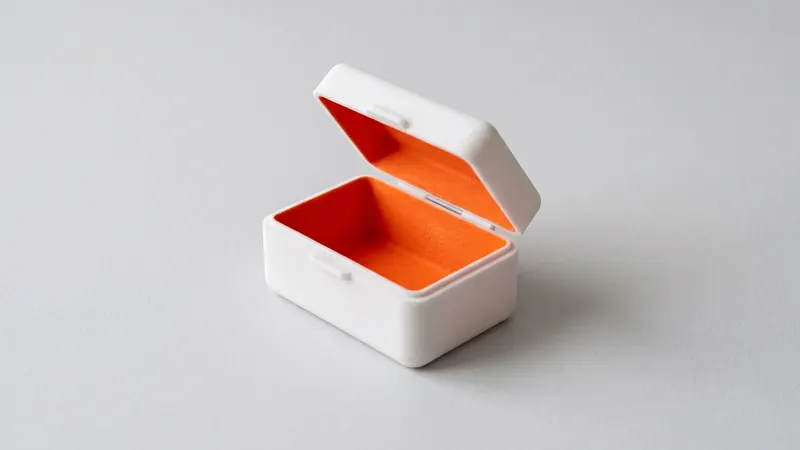
A living hinge is a thin, flexible strip that joins two rigid parts of the same piece, like the lid of a shampoo bottle. In injection-molded polypropylene it can flex many thousands of times. Laser-sintered PA 12 is a different material, and a living hinge printed in it behaves differently. This guide explains what SLS hinges can realistically do, how to design one that survives, and when a print-in-place pin hinge is the smarter choice.
The short answer
Living hinges can be printed in SLS PA 12, but treat them as limited-cycle hinges: lids that are opened now and then, tabs that bend once during assembly, flexible clips and cable holders. If the hinge has to open and close all day for years, a molded polypropylene part or a mechanical pin hinge is the better solution.
| Use | SLS living hinge | Better alternative |
|---|---|---|
| Bends once during assembly (fold-and-lock) | Works well | - |
| Lid opened occasionally (prototype, spare part, small series) | Works with a tested design | Pin hinge if it must last |
| Flexible clip or strain relief with small movement | Works well | - |
| Hinge cycled many times a day | Not recommended | Print-in-place pin hinge or molded PP |
| Hinge under permanent load | Not recommended | Pin hinge with a metal pin |
Why PA 12 is not polypropylene
Polypropylene is famous for living hinges because molding orients its polymer chains across the hinge, which makes the thin strip extremely resistant to repeated bending. Laser sintering does not orient the material this way. A sintered part is built from fused powder grains, layer by layer, and has a slightly porous surface. That gives SLS nylon its strength and toughness for brackets and housings, but less fatigue life in a thin, heavily bent strip.
The key figure is the elongation at break. For PA 2200, the PA 12 powder we print, EOS gives 18 % within the layer plane and 4 % across the layers. A living hinge works by stretching the outer surface of the strip as it bends. The thinner the strip and the larger its bending radius, the lower that strain. The design goal is simple: keep the strain well below what the material can take, and keep it in the direction where the material is strongest.
Design rules for SLS living hinges
Orient the hinge within the layers
The bending strip should lie flat in the layer plane, with the hinge axis also in that plane. A hinge that has to bend across the layers relies on the weaker bond between layers and fails much earlier. If one orientation of the part matters for the hinge, mention it when you order; print preparation chooses the orientation for the whole print job.
Spread the bend over a length
A hinge that is too short concentrates the whole bend in a narrow zone. A longer flexible zone distributes the strain and lets the hinge open further before the surface overstretches. In practice, give the hinge a clearly defined flexible length rather than a sharp notch.
Round every transition
The hinge almost never breaks in the middle. It breaks where the thin strip meets the thick body, because that corner concentrates stress. Generous fillets on both sides of the hinge, top and bottom, are the single most effective improvement.
Thin, but printable
A thinner strip bends with less strain, but SLS has a minimum printable wall thickness and very thin features are fragile when the parts are depowdered and blasted. The right thickness depends on the hinge length, the opening angle, how often it will bend and how much load it carries, so there is no universal number. The reliable method is a test coupon: a strip of hinges with several thicknesses and lengths side by side. It is a small part, so it costs little, and the calculator prices it instantly.
Limit the opening angle
A hinge that only has to open 90° lives much longer than one that folds flat by 180°. If the lid only needs to give access, add a stop that limits the angle.
Break it in before use
Bending a fresh SLS hinge a few times gently, through its full working range, helps it settle. Do not bend it beyond the designed angle.
Checklist before you order
- The hinge strip lies in the layer plane, and you have said so if it matters.
- Fillets at both ends of the strip, on both faces.
- A defined flexible length, not a notch.
- An angle stop if the lid does not need to fold flat.
- No permanent load on the hinge (springs, heavy lids).
- A test coupon with several thicknesses printed first if the hinge is critical.
- Enough clearance around the hinge so the lid closes without rubbing: see SLS tolerances and clearances.
When a pin hinge is the better choice
SLS has an advantage that molding does not: it prints moving parts already assembled. Instead of a strip that bends, you can print two knuckles and a pin with a gap between them. The material does not have to flex at all, so the hinge can turn many more times and carry more load. The rules are a gap of at least 0.5 mm between the moving surfaces and a way for the loose powder to get out. The guide to print-in-place hinges and moving assemblies covers the details.
| Living hinge | Print-in-place pin hinge | |
|---|---|---|
| How it moves | The material bends | Two parts rotate around a pin |
| Cycle life in SLS PA 12 | Limited | Much higher |
| Space needed | Very little | Room for knuckles and gap |
| Feel | Springy, returns slightly | Free-moving, slight play |
| Best for | Fold-and-lock, occasional lids, clips | Frequent use, loaded lids, doors |
A third option is a hinge with a metal pin pushed through two printed knuckles. It is the most robust and is easy to service. Snap-fit lids are another way to avoid hinges altogether.
Finishing and color
Our parts are glass-bead blasted and polished in a DyeMansion Powershot DUAL, included in the price. According to DyeMansion, the process compacts the surface without removing material, so a hinge keeps its designed thickness; edges are slightly rounded, which helps rather than hurts. Dyeing with TCN liquid dyes colors the surface layer without adding a coating, so it does not stiffen the hinge. According to DyeMansion, the dye penetrates about 0.2 mm into PA 2200. All 61 shades of the color catalog are priced instantly in the calculator.
When to get design help
If the hinge carries load, must survive a defined number of cycles or is part of a product, the decision between living hinge, pin hinge and molded part depends on the whole design intent. The specialists at prototype.builders can review it with you and test variants. For the material itself see the PA12 nylon guide, and for wall thicknesses and minimum features the SLS design guidelines.
Frequently asked questions
Can you 3D print a living hinge with SLS?
Yes, for hinges that flex a limited number of times, such as the lid of a box opened occasionally or a clip that bends during assembly. Laser-sintered PA 12 is far less ductile than molded polypropylene, so a printed living hinge will not reach the life of a molded one.
How thick should a living hinge be in SLS PA 12?
There is no single number. The hinge must be thin enough to bend without overstretching the material and thick enough to print reliably and carry the load. Print a test coupon with several thicknesses and lengths and bend it the way the real part will be used.
How should a living hinge be oriented in the printer?
The bending strip should lie within the layer plane. EOS gives an elongation at break of 18 % within the layers for PA 2200 but only 4 % across them, so a hinge that bends across the layers breaks much sooner.
Is polypropylene better for living hinges?
For high cycle counts, yes. Molded polypropylene is the classic living-hinge material. SLS PA 12 is the right choice when the hinge is part of a complex nylon part that you need quickly or in small quantities.
What is the alternative to a living hinge in SLS?
A print-in-place pin hinge: two knuckles and a pin printed already assembled, with a gap of at least 0.5 mm and a path for the powder to escape. It does not rely on the material bending, so it lasts much longer.
Does dyeing affect a living hinge?
Dyeing colors the surface layer without adding a coating, so it does not change the way the hinge bends. Very thin hinges should still be tested in the final color and finish.
Get an instant price
Upload STEP or STL files to the calculator and see the price of your parts in seconds: white Nylon PA 12, blasting and polishing included, optional dyeing in 61 colors, three delivery speeds. From there you send the order preview for confirmation.
Another material, an NDA or a large series? Write to us. For design help and prototype development see prototype.builders.
Get an instant price