
Small-Batch Production with SLS: How to Plan 10 to 500 Nylon Parts
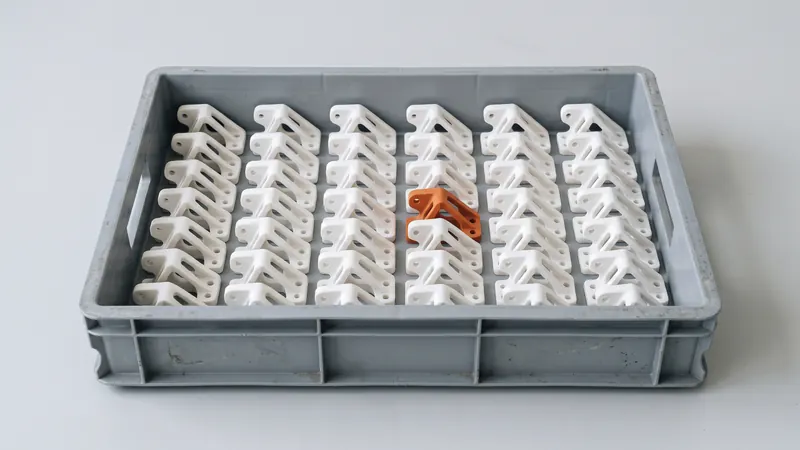
Between a prototype and a molded series there is a range of quantities where SLS 3D printing is often the most practical way to make parts: tens to hundreds of identical or similar nylon parts, without a mold and without a minimum run. This guide explains how SLS handles a small series, what lowers the price per part, how to keep parts consistent from one order to the next, and when a mold starts to pay off.
Why SLS suits small series
- No tooling, no setup per design. There is no mold and no fixture to pay for, so the first part and the hundredth cost about the same. A design change between two batches costs nothing more than a new upload.
- Many parts in one print job. SLS needs no support structures, so parts are stacked in three dimensions in the 200 × 250 × 330 mm chamber of our EOS FORMIGA P 110 Velocis. A series of small parts fills the chamber efficiently.
- The same material from prototype to series. The prototype and the series part are both white PA 12 (EOS PA 2200), so what you tested is what you get. EOS gives a tensile strength of 48 MPa in X/Y and 42 MPa in Z for this material, so the properties stay close in every direction.
- Finishing included. Every part is blasted and polished in a DyeMansion Powershot DUAL; dyeing in one of 61 colors is optional.
How the price behaves with quantity
Without a mold, the price of each part follows the space and material it needs, so 100 parts cost roughly 100 times one part. What lowers the price per part is the size of the order: above a certain total volume of parts in one order, a volume discount on printing applies and grows with the order. A few points follow from that:
- Total volume counts, not the number of pieces. Fifty large housings reach a higher discount than fifty small clips.
- Different parts in one order count together. If your product needs a kit of several parts, order the whole kit at once rather than part by part.
- One larger order beats several small ones. One order of 300 parts costs less per part than three orders of 100.
- The delivery level matters. Express, Standard or Economy: a longer lead time lets parts wait for the most efficient print job and costs less.
The calculator shows all of this directly: change the quantity or the delivery level and the price updates at once. More on the price drivers in how much SLS 3D printing costs.
Quantities and what to watch
| Quantity | Typical use | What to watch |
|---|---|---|
| 1 to 10 | Prototypes, test parts, first fit checks | Test fits and assembly before you order more |
| 10 to 50 | Pilot series, fixtures, spare parts | Freeze the design revision; check the color on a sample if it matters |
| 50 to 200 | Small series, product launch, kits | Order the real demand at once; keep critical features within the tolerance guideline |
| 200 to 500 and more | Ongoing small series | Compare with the break-even point of a mold; for regular call-offs of a large series, write to us |
Consistency across a series
Every part of a series is printed on the same machine, from the same powder and with the same process, then blasted and polished the same way. To keep the parts as alike as possible from one order to the next:
- Design to the tolerance guideline. We use ±0.3 % (at least ±0.3 mm) as our design guideline. Parts that mate need clearances, not zero gaps; see SLS tolerances and clearances. Measure the first parts and keep critical features within that range.
- Fix the layer plane for critical parts. In the calculator you choose the layer plane of each part (XY, XZ, YZ) or let us decide, which picks the lowest price that fits. Holes and shafts are roundest when their axis is vertical. If round features are critical, choose the layer plane yourself, so every batch is printed the same way.
- Order matching colors together. Parts dyed together in one batch are very consistent; between batches small differences are possible. Black (GTD 8485) and orange (GTD 8645) are in stock and keep the delivery time of the chosen level; the other 59 colors add about one month (20 working days), at the same price. See dyeing SLS parts and the color catalog.
- Keep one file per revision. Name files with the revision, so a reorder uses exactly the geometry you approved.
Planning deliveries
Choose the delivery level per order: Express when the series is on the critical path, Standard for most orders, Economy when you can plan ahead. Add the extra month for a color that is not in stock. If you need parts regularly, there are two ways to plan: one larger order, which gives the lowest price per part, or smaller orders when you need them, which keeps your own stock low. Both work without a mold and without a minimum run.
Preparing files for a series
- One file per part or one file for a kit. The calculator splits a file with several solids into its parts and merges identical bodies into the quantity; see units, scale and multi-body files.
- Check units and size. A part 25.4 times too small or too large was exported in inches or read in the wrong unit.
- Design for packing. Compact, flat or nestable parts leave room for others and cost less than bulky ones; hollow thick sections and add escape holes.
- Mark the parts if you need traceability. Embossed or engraved revision letters or serial numbers are free in SLS; see text and logos on SLS parts.
- Read the design review. Enclosed cavities, thin walls and other notes apply to every part of the series, so fix them before ordering hundreds.
When to move to injection molding
A mold makes sense when the design is frozen, demand is proven and quantities reach the point where the mold cost is paid back: roughly the mold cost divided by the difference between the SLS price per part and the molded price per part. For complex or small parts and changing designs, that point can lie far above a few hundred parts. Many products use both: SLS for the launch and the first series while the mold is being made, molding afterwards. The comparison is in SLS vs injection molding.
Checklist before you order a series
- The design revision is frozen and tested on a few parts.
- Critical fits follow the tolerance guideline and were measured on the first parts.
- The layer plane is fixed for parts with critical round features.
- Parts that must match in color are ordered together; the color lead time is planned.
- The whole kit or the real demand is in one order.
- The delivery level matches the real deadline.
If the series needs design work first, for example converting a machined or molded part into a printable one, the specialists at prototype.builders can help.
Frequently asked questions
Is SLS suitable for small-batch production?
Yes. SLS needs no mold or setup per design and prints many parts in one print job, so tens to hundreds of PA 12 parts are a typical use, from pilot series to spare parts and product launches.
Does the price per part fall with quantity?
Not because of the count itself, but because of the order size: above a certain total volume of parts in one order, a volume discount on printing applies and grows with the order. One larger order is cheaper per part than several small ones.
Will all parts of a series be the same?
They are printed on the same machine from the same powder with the same process and finished the same way. Design critical fits to our guideline of ±0.3 % (at least ±0.3 mm) and order parts that must match in color together.
How long does a small series take?
It depends on the delivery level you choose: Express, Standard or Economy. Black and orange are in stock; the other 59 colors add about one month (20 working days).
Can I reorder the same part later?
Yes. Upload the same file revision again and choose the same options. Your requested quotes stay in your account. Parts that must match in color are best ordered in one batch.
When should I switch to injection molding?
When the design is frozen, demand is proven and the quantity passes the break-even point: roughly the mold cost divided by the price difference per part. Until then, SLS can bridge the time while a mold is made.
Get an instant price
Upload STEP or STL files to the calculator and see the price of your parts in seconds: white Nylon PA 12, blasting and polishing included, optional dyeing in 61 colors, three delivery speeds. From there you send the order preview for confirmation.
Another material, an NDA or a large series? Write to us. For design help and prototype development see prototype.builders.
Get an instant price