
3D Printing in Automotive: Prototypes, Clips, Brackets and Fixtures in SLS Nylon
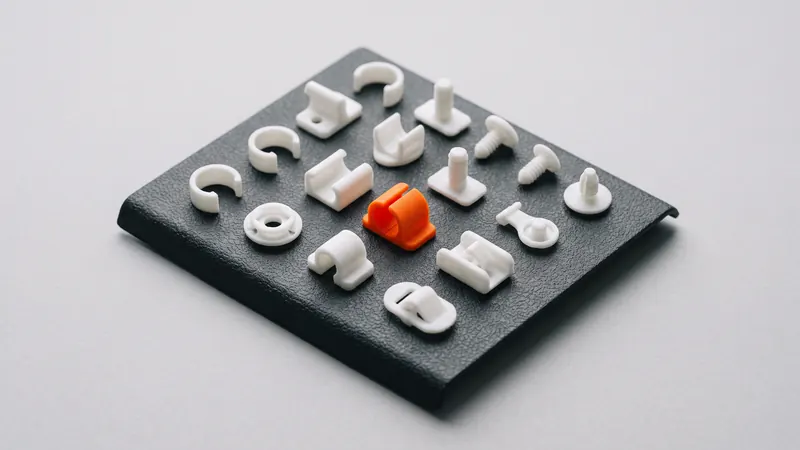
Automotive development and production need many small plastic parts long before, and long after, an injection mold exists: prototypes of clips and brackets, assembly fixtures and gauges, cable guides, covers and parts for small series and special vehicles. Laser-sintered PA 12 is a common material for this work. This guide shows where SLS nylon fits in automotive projects, which properties matter and where its limits are.
Where SLS fits in automotive work
EOS itself lists spare parts such as brackets or covers, for example in the automotive industry, as a typical application of its PA 2200 powder, the material we print. In practice SLS is used in three phases of a vehicle project:
- Development: functional prototypes that are installed, tested and changed before tooling is ordered.
- Production support: fixtures, gauges, drill templates and assembly aids for the line or the workshop.
- Small series: parts for special vehicles, conversions, prototype fleets and replacement parts in quantities where a mold does not pay off.
Typical automotive applications
| Application | Examples | Why SLS |
|---|---|---|
| Functional prototypes | Clips, brackets, air ducts, covers, interior trim pieces | Real material, fit and assembly tests, changes in days |
| Assembly aids and fixtures | Positioning jigs, drill templates, gauges, protective caps | Light, shaped to the part, poka-yoke features built in |
| Cable and hose management | Cable clips, hose holders, grommet carriers | Snap-fits and undercuts without supports |
| Housings and brackets | Sensor holders, electronics housings, mounting brackets | Ribs, bosses and inserts in one part |
| Small series and spare parts | Parts for special vehicles, conversions, discontinued plastic parts | No mold, consistent parts from one print job |
For fixtures and templates see 3D-printed drill templates, jigs and fixtures; for housings see 3D-printed enclosures.
Properties that matter in a vehicle
Strength and toughness
For PA 2200, EOS gives a tensile strength of 48 MPa within the layers and 42 MPa across them, and an elongation at break of 18 % and 4 %. That toughness is why clips and snap-fits work in PA 12. Orient flexing features so the strain lies within the layers; details in snap-fit joints in SLS PA 12 and how strong SLS nylon is.
Oils, fuels and other fluids
PA 12 generally resists oils, greases, fuels and hydrocarbons well, which is one reason it is common in automotive development. Strong acids and oxidizing agents are not suitable. Check the specific fluid, temperature and exposure time for your application.
Temperature
For PA 2200, EOS gives a heat deflection temperature of 64 °C at 1.80 MPa and 157 °C at 0.45 MPa, and a melting point of 176 °C. Stiffness falls as temperature rises. A car interior parked in the sun and the engine compartment can get much hotter than a workshop, so loaded parts in warm areas must be designed with margin and tested in place. Parts near the exhaust or other hot components are not a job for PA 12.
Flammability
EOS rates PA 2200 UL 94 HB at 0.5, 1.6 and 3.2 mm. Vehicle interiors usually have their own flammability requirements, which have to be checked on the finished part. We do not test or certify parts to automotive standards.
What SLS nylon is not for
- Safety-relevant parts: anything in braking, steering, restraint systems or the structure of the vehicle.
- Hot zones: parts near the exhaust, turbocharger or other components that run well above the heat deflection values.
- Parts that need approval: whether a part may be installed in a road vehicle is the responsibility of whoever designs and fits it. We print to your model and do not issue approvals.
- Visible class-A surfaces: SLS parts have a matte, slightly grainy surface; a glossy or exactly color-matched trim surface needs another process.
Design tips for automotive parts
- Clips and snap-fits: keep the strain moderate, round the root of every hook and test the clip on the real mating part.
- Brackets: use ribs instead of solid sections, round inside corners and use metal inserts for screws that are tightened often or carry vibration.
- Fits to existing parts: our design guideline is ±0.3 % with a lower limit of ±0.3 mm. Give clearance where the part meets sheet metal or trim, and check against the real vehicle. More in SLS tolerances and clearances.
- Walls and cavities: the calculator warns about walls below about 0.8 mm and expects at least two escape holes of at least 5 mm per closed cavity.
- Size: our chamber is 200 × 250 × 330 mm; longer parts are split and joined.
Color and finish
Every part is glass-bead blasted and polished in a DyeMansion Powershot DUAL, included in the price. Black, the usual choice for interior and engine-compartment parts, and orange are in stock with the normal lead time. All 61 colors of the color catalog can be chosen in the calculator with an instant price; colors that are not in stock take about one month longer to deliver. The dye penetrates the surface layer instead of coating it, but a dyed SLS part is matte and will not exactly match a molded trim color.
From prototype to small series
A typical path: print one or two parts, install them, adjust clearances and clip strength, then order the series. Because every part of an order goes through the same print job and finishing, the parts are consistent. Variants, such as left and right versions or brackets for different model years, need no tooling and can be ordered side by side. When volumes grow into the thousands, compare with injection molding: see SLS vs injection molding. For development projects that need design work and testing, the specialists at prototype.builders can help.
Frequently asked questions
Is SLS PA 12 used in the automotive industry?
Yes. EOS lists spare parts such as brackets or covers in the automotive industry as a typical application of PA 2200. SLS is widely used for functional prototypes, fixtures, assembly aids and small series of plastic parts.
Can 3D-printed nylon parts be used in the engine compartment?
Only with care. EOS gives a heat deflection temperature of 64 °C at 1.80 MPa and 157 °C at 0.45 MPa for PA 2200. Lightly loaded parts away from hot components can work; parts near the exhaust or turbocharger cannot. Test in place.
Is PA 12 resistant to oil and fuel?
PA 12 generally resists oils, greases, fuels and hydrocarbons well. Strong acids and oxidizing agents are not suitable. Check the specific fluid, temperature and exposure for your application.
Can I print replacement parts for my car?
Non-safety plastic parts such as clips, covers, holders and trim pieces are common candidates. Whether a part may be installed in a road vehicle is the responsibility of whoever designs and fits it; safety-relevant parts are not a job for printed nylon.
Are SLS parts certified to automotive standards?
No. EOS rates PA 2200 UL 94 HB at 0.5, 1.6 and 3.2 mm, but vehicle-specific requirements must be tested on the finished part. We do not test or certify parts to automotive standards.
Can printed parts match the color of my car interior?
Black and orange are in stock, and 61 colors can be chosen in the calculator. Dyed SLS parts are matte and slightly grainy, so they will not exactly match a molded trim surface.
Get an instant price
Upload STEP or STL files to the calculator and see the price of your parts in seconds: white Nylon PA 12, blasting and polishing included, optional dyeing in 61 colors, three delivery speeds. From there you send the order preview for confirmation.
Another material, an NDA or a large series? Write to us. For design help and prototype development see prototype.builders.
Get an instant price