
3D-Printed Springs, Flexures and Compliant Mechanisms in SLS PA 12
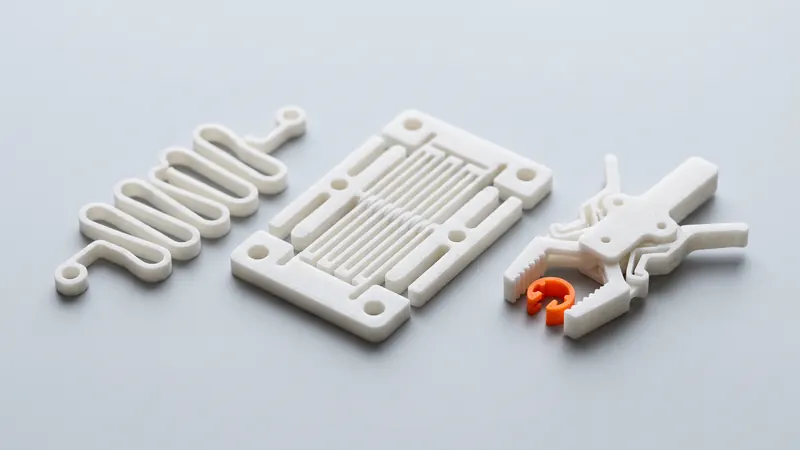
A compliant mechanism moves by bending instead of sliding or rotating on a pin: a flat spring, a flexure hinge, a one-piece gripper or a clip that returns to its shape. SLS 3D printing in PA 12 is well suited to these parts, because nylon is tough and the shapes need no support structures. This guide explains how to estimate strain and stiffness, which design rules make flexures last, where plastic springs reach their limits and how to test a design quickly.
What compliant mechanisms are
Instead of two parts turning around a pin, a compliant mechanism uses a thin, flexible section that bends. Typical examples:
- Flat and serpentine springs that push a part back into position.
- Cantilever springs such as detents, latches and spring-loaded buttons.
- Flexure hinges that let one part rotate a few degrees relative to another.
- Parallel flexure guides that move a part in a straight line without sliding.
- One-piece grippers and clamps that close when pressed.
- Bistable mechanisms that snap between two stable positions.
The advantages are the same in each case: one part instead of an assembly, no play, no friction or wear in joints, no lubrication and nothing to lose. The price is a limited range of motion and a careful look at the strain in the bending zone.
Why SLS PA 12 suits flexures
For PA 2200, the PA 12 we print, EOS gives a tensile modulus of 1,650 MPa, a tensile strength of 48 MPa and an elongation at break of 18 % within the layer plane. That combination of moderate stiffness and good elongation is what a flexure needs: it bends noticeably without breaking. Because SLS needs no support structures, thin flexures, nested springs and closed frames are printed as designed. Across the layers, EOS gives only 4 % elongation and 42 MPa, so the direction of bending matters as much as the shape. See how strong SLS nylon is.
Estimating strain in a bending beam
Most flexures and springs behave like a beam that bends. For a straight cantilever of constant rectangular section, the classic estimate of the strain at the root is:
strain ε = 1.5 × t × y ÷ L²
- t = thickness of the beam in the bending direction
- y = deflection at the tip
- L = free length of the beam
Strain grows with thickness and deflection and falls with the square of the length. A longer beam is the most effective way to get more travel with less strain. Keep the calculated strain well below the 18 % that EOS gives for the layer plane, and lower still for parts that bend many times; elongation at break is the point where a test bar breaks, not a design value. The same rule is explained for clips in snap-fit joints in SLS PA 12.
Estimating stiffness
For the same cantilever, the spring rate at the tip is approximately:
k = E × b × t³ ÷ (4 × L³)
with b the width of the beam and E the modulus. With E = 1,650 MPa, a beam 10 mm wide, 1.5 mm thick and 30 mm long gives about 0.5 N per millimeter of deflection. The cube of thickness and length dominates: 10 % more thickness makes the spring about a third stiffer, 10 % more length makes it about a quarter softer. Treat the result as a starting point. The real stiffness of a sintered part depends on the layer direction, the wall surface and the exact thickness after finishing, so measure the first parts and adjust.
| Change | Effect on strain | Effect on stiffness |
|---|---|---|
| Longer beam | Falls with the square of the length | Falls with the cube of the length |
| Thicker beam | Rises in proportion | Rises with the cube of the thickness |
| Wider beam | No change | Rises in proportion |
| More deflection | Rises in proportion | Force rises in proportion |
To make a flexure stiffer without more strain, make it wider. To get more travel, make it longer or fold it into a serpentine.
Design rules for SLS flexures and springs
- Bend within the layer plane. The flexing direction and the length of the beam should lie in the layer plane. In the calculator you can choose the layer plane per part (XY, XZ or YZ) or let us decide.
- Round the ends. Fillets where the flexure meets the rigid body spread the stress; a sharp corner is where cracks start.
- Prefer leaf flexures to notch hinges. A short notch concentrates all the bending in a tiny zone. A longer, uniform leaf distributes it and lasts longer.
- Do not go too thin. The calculator warns below 0.8 mm, and thin features can break during depowdering and blasting. Gain flexibility with length, not with thinness.
- Add stops. A rib that limits the travel protects the flexure from being overstretched.
- Keep gaps open. Between moving and fixed sections, leave at least 0.5 mm so the powder can be removed and nothing fuses; see print-in-place hinges and assemblies.
- Check the tolerance. Thickness varies within our design guideline of ±0.3 % (at least ±0.3 mm), and stiffness follows the cube of the thickness, so a thin flexure varies more in stiffness than in size.
Limits of plastic springs
- Creep and relaxation. Under a permanent load or deflection, plastics slowly give way, and a spring held compressed loses part of its force over time. This happens faster in warm conditions; EOS gives a range of -40 to +80 °C for PA 2200 under steady stress. Compliant mechanisms that move and return to rest work better than springs that stay preloaded.
- Fatigue. The number of cycles a flexure survives depends on its strain, its surface and its direction. For mechanisms that move many times, keep the strain low and test.
- Precision of force. A printed spring is not a calibrated spring. Where a force must be exact or constant for years, use a metal spring and design the printed part to hold it.
- Living hinges. A thin hinge that folds by a large angle is a special case with its own rules; see living hinges in SLS nylon.
Test before you commit
Stiffness and life are easier to test than to calculate exactly. Print a coupon with three to five flexures of different thicknesses or lengths, measure the force at a known deflection and bend them as often as the real part will bend. Small coupons cost little, and the calculator shows the price as soon as you upload the file. For the general design rules, see the SLS design guidelines.
Finish and color
Every part is glass-bead blasted and polished in a DyeMansion Powershot DUAL. According to DyeMansion, the process compacts the surface without removing material, so the designed thickness stays as it is. Dyeing in one of 61 colors is optional; black and orange are in stock, the other 59 colors add about one month (20 working days) to the delivery time.
Need help designing a compliant mechanism for a product? The engineers at prototype.builders can take on the design and testing.
Frequently asked questions
Can you 3D print a working spring?
Yes. Flat springs, serpentine springs, cantilever springs and flexures work well in SLS PA 12 when the strain in the bending zone stays well below the elongation at break. They suit light forces and moderate cycle counts; for high forces or precise, long-lasting spring rates, a metal spring is better.
What is a compliant mechanism?
A mechanism that gets its motion from the elastic bending of flexible sections instead of from joints, pins or bearings. It is made in one piece, has no play or friction in the joints and needs no assembly.
Which layer direction is best for flexures?
The bending section should flex within the layer plane. For PA 2200, EOS gives an elongation at break of 18 % in the layer plane and 4 % across the layers. In the calculator you can choose the layer plane per part.
Do 3D-printed plastic springs lose force over time?
Under a permanent load or deflection, plastics creep and relax, more so when warm. A PA 12 spring that is held compressed for a long time can lose part of its force. Design for intermittent loads, or use a metal spring where the force must stay constant.
How thin can a flexure be in SLS?
The calculator warns about walls thinner than 0.8 mm, and very thin features are fragile during depowdering and blasting. Make flexures longer rather than thinner, and print a test coupon with several thicknesses if the stiffness matters.
Get an instant price
Upload STEP or STL files to the calculator and see the price of your parts in seconds: white Nylon PA 12, blasting and polishing included, optional dyeing in 61 colors, three delivery speeds. From there you send the order preview for confirmation.
Another material, an NDA or a large series? Write to us. For design help and prototype development see prototype.builders.
Get an instant price