
How Strong Is SLS Nylon? Strength, Stiffness and Toughness of PA 12
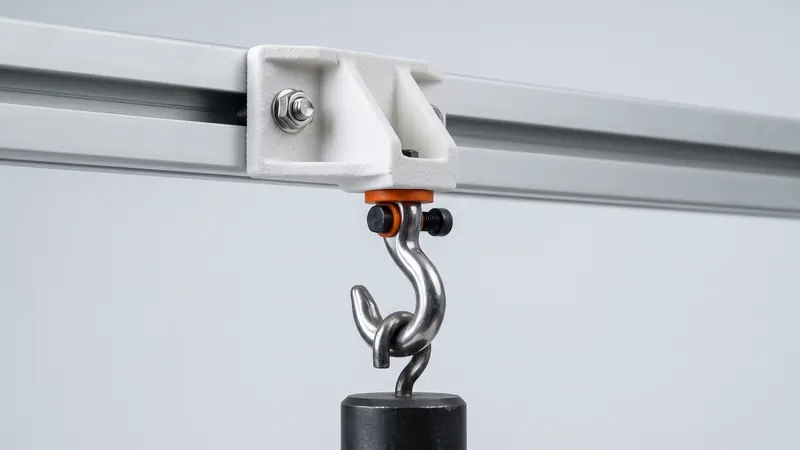
Laser-sintered nylon is used for brackets, housings, clips, jigs and machine parts, so the first question about a new part is usually: will it hold? This guide explains the strength of SLS PA 12 in plain terms, using the figures EOS publishes for the PA 2200 powder we print, shows how printing direction, temperature and time affect them, and gives practical rules for designing parts that carry load.
The numbers EOS publishes
We print white PA 12 from EOS's PA 2200 powder on an EOS FORMIGA P 110 Velocis. EOS publishes these values for the material, measured on test specimens:
| Property (EOS, PA 2200) | Within the layers (XY) | Across the layers (Z) |
|---|---|---|
| Tensile strength | 48 MPa | 42 MPa |
| Elongation at break | 18 % | 4 % |
| Heat deflection temperature, 1.80 MPa | 64 °C | |
| Heat deflection temperature, 0.45 MPa | 157 °C | |
| Melting point | 176 °C | |
These are material values for test bars, not a guarantee for every part. A real part's strength also depends on its geometry, wall thickness, orientation in the print job, notches and the load case. For design calculations, use the material datasheet and test the critical part.
What these numbers mean in practice
- Tensile strength around 45 MPa is comparable with many molded engineering plastics. Hooks, brackets and housings with sensible sections carry real loads.
- Elongation at break of 18 % within the layers means the material is tough: it bends before it breaks, which is why snap-fits and clips work in SLS PA 12.
- 4 % across the layers is the limit to remember: features that bend so that the layers are pulled apart should be avoided or oriented differently.
- Stiffness is far below metals. Thin walls flex noticeably; ribs and larger sections make parts stiff.
Direction: why orientation matters
SLS builds parts layer by layer. Each layer is fused across its whole cross-section, so the difference between directions is much smaller than in filament printing. It still exists: the bond between layers is slightly weaker, and elongation across the layers is clearly lower. For parts that carry tension or bending in one direction, or that must snap, the critical strain should lie within the layers. Print preparation chooses the orientation for the whole print job; if one direction is critical for your part, mention it when you order.
Temperature and time
Heat
Like all thermoplastics, PA 12 gets softer as it gets warmer. EOS gives a heat deflection temperature of 64 °C under 1.80 MPa and 157 °C under 0.45 MPa for PA 2200. A lightly loaded cover near a warm motor is fine; a bracket carrying a heavy load at 80 °C is not. Keep loaded parts well below the heat deflection temperature that matches the stress in the part.
Creep
Under a constant load, nylon slowly deforms over time, and faster when it is warm. That matters for press fits, clamped joints, screw connections and parts that carry a load permanently. Design with margin, use metal inserts or washers where screws clamp plastic, and test parts that must hold a load for months.
Moisture
PA 12 absorbs much less water than PA6 or PA66, so its strength and stiffness change little with humidity. The comparison is in PA12 vs PA11 vs PA6.
SLS nylon compared with other printed plastics
| Process and material | Behavior under load |
|---|---|
| SLS PA 12 | Tough, fairly uniform in all directions, good for clips, brackets, housings, fixtures |
| FDM filament parts | Strong along the lines, clearly weaker across layers; quality depends on printer and settings |
| SLA/DLP resin parts | Fine detail and smooth surfaces; standard resins are often more brittle, special resins vary |
The comparisons in detail: SLS vs FDM and SLS vs SLA.
How to design SLS parts for load
- Use ribs instead of thick blocks. Ribs add stiffness with little material; solid lumps add weight, cost and shrinkage.
- Round inner corners. Sharp internal corners concentrate stress; fillets are the cheapest strength upgrade.
- Keep walls even. Uniform wall thickness gives predictable strength and accurate parts.
- Spread point loads. Use bosses, washers or metal inserts where screws, pins or hooks apply force; see threads and heat-set inserts.
- Mind the layer direction for bending and snap features; see snap-fit joints.
- Allow for creep and heat in permanently loaded or warm parts.
- Test the critical part. A test print costs little with an instant price; a failing part in the field costs much more.
The general rules for walls, holes and minimum features are in the SLS design guidelines.
Finishing and dyeing do not weaken the part
Every part is glass-bead blasted and polished in a DyeMansion Powershot DUAL, included in the price; according to DyeMansion, the process compacts the surface without removing material. Dyeing with TCN liquid dyes colors the surface layer, about 0.2 mm deep in PA 2200 according to DyeMansion, without a coating. Neither step is meant to change the strength of the part.
Impact and fatigue
PA 12 is tough: parts tend to deform before they break and survive drops and knocks that would crack more brittle plastics. Repeated loading is a different matter. Parts that flex millions of times, such as springs or vibrating brackets, should be designed with low strain, generous fillets and no sharp notches, and tested under realistic conditions before use.
When to get the design reviewed
Safety-relevant parts, parts under permanent load, parts that replace metal and parts near their temperature limit need more than rules of thumb. The specialists at prototype.builders can review the load case and the design intent with you. More about the material in the PA12 nylon guide.
Frequently asked questions
How strong is SLS nylon PA 12?
For PA 2200, EOS gives a tensile strength of 48 MPa within the layers and 42 MPa across them, and an elongation at break of 18 % and 4 %. That is in the range of many molded engineering plastics and enough for brackets, housings, clips and fixtures designed with ribs and even walls.
Is SLS stronger than FDM?
SLS parts are generally more uniform: each layer is fused across its whole cross-section, while FDM parts depend on the bond between extruded lines and are clearly weaker across the layers. A well-printed FDM part can still be enough for light loads.
Are SLS parts weaker in one direction?
Yes, somewhat. EOS gives 48 MPa within the layers and 42 MPa across them for PA 2200; the difference in elongation at break is larger (18 % against 4 %). Parts that bend or snap should be oriented so the critical strain lies within the layers.
How hot can SLS PA 12 parts get?
EOS gives a heat deflection temperature for PA 2200 of 64 °C at 1.80 MPa and 157 °C at 0.45 MPa, and a melting point of 176 °C. Stiffness falls as temperature rises, so loaded parts should stay well below these values.
Can SLS nylon replace metal parts?
Sometimes, when the loads are moderate and the design uses the freedom of SLS: ribs, larger sections, integrated features. PA 12 is much less stiff than aluminum or steel, so a direct copy of a metal part is rarely the right design.
Do SLS parts creep under constant load?
Yes, like all thermoplastics, nylon slowly deforms under constant load, more at higher temperature. Press fits, clamped joints and parts under permanent load should be designed and tested with that in mind.
Get an instant price
Upload STEP or STL files to the calculator and see the price of your parts in seconds: white Nylon PA 12, blasting and polishing included, optional dyeing in 61 colors, three delivery speeds. From there you send the order preview for confirmation.
Another material, an NDA or a large series? Write to us. For design help and prototype development see prototype.builders.
Get an instant price