
SLS vs SLA: Which Process for Functional Parts?
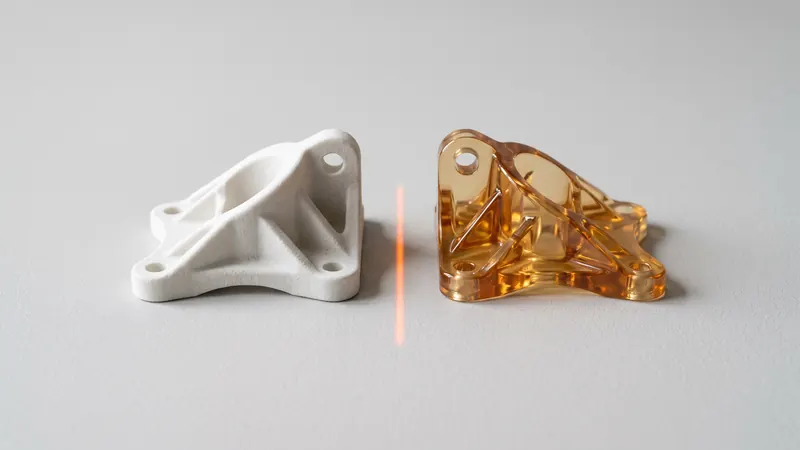
SLS and SLA are both industrial 3D printing processes with a three-letter name, and they are often confused. They work in very different ways and produce very different parts: SLS sinters nylon powder into tough, matte functional parts, SLA cures liquid resin into smooth, detailed parts. This comparison explains the differences and shows honestly when each process is the better choice.
How the two processes work
SLS: selective laser sintering
A laser fuses thin layers of thermoplastic powder, in our case white Nylon PA 12, inside a heated chamber. The unfused powder supports the part, so no support structures are needed and many parts can be nested in one print job, stacked in all three dimensions. After printing, the parts cool in the powder, are unpacked and cleaned, then blasted and polished. More in what is SLS 3D printing.
SLA: stereolithography
A light source, a laser or a projected image, cures a liquid photopolymer resin layer by layer. The part hangs from or stands on a platform and needs support structures wherever it overhangs. After printing, the parts are washed to remove uncured resin, the supports are cut off, and the parts are post-cured with UV light and heat to reach their final properties.
Side-by-side comparison
| Property | SLS (PA 12) | SLA (resin) |
|---|---|---|
| Material | Thermoplastic nylon, the same family as molded nylon parts | Thermoset photopolymer resins; standard, tough, rigid, flexible, clear and high-temperature grades exist |
| Toughness | Tough and ductile; for PA 2200, EOS gives 18 % elongation at break in the layer plane | Standard resins are often brittle; engineering resins are tougher |
| Surface | Matte, slightly grainy; uniform after blasting and polishing | Smooth, almost injection-molded look; support marks where supports touched |
| Fine detail | Good; limited by the powder and 0.12 mm layers | Very good; sharp edges and fine features |
| Supports | None; the powder supports the part | Required on overhangs; removed by hand |
| Internal channels and assemblies | Possible if the powder can escape | Possible but limited by supports and resin drainage |
| Transparency | No; white or dyed opaque | Clear resins available |
| Color | Natural white or dyed through the surface layer (61 colors with TCN dyes) | Resin color, or painted |
| Long-term behavior | Stable thermoplastic; PA 12 absorbs little moisture | Some resins change properties with UV exposure and age |
| Batch production | Efficient; parts nested in three dimensions | Parts placed on the platform in one layer |
Strength and durability
The main difference is the material class. PA 12 is a thermoplastic: it yields and stretches before it breaks, which is why SLS parts survive snap-fits, living features, drops and vibration. EOS gives a tensile strength of 48 MPa within the layer plane and 42 MPa across the layers for PA 2200, so properties are close to the same in every direction.
Photopolymer resins are thermosets. Standard resins are stiff and hard but tend to crack rather than bend; engineering resins designed to mimic ABS or polypropylene improve on that, and some high-temperature resins exceed nylon in heat resistance. Resin properties are also more dependent on correct washing and post-curing, and some grades become more brittle with UV exposure over time.
For a part that will be clipped, screwed, loaded or used outside a display cabinet, SLS is usually the safer choice. For a part that must look perfect but carries little load, SLA often wins.
Surface and detail
SLA is the clear winner on surface. Cured resin is smooth and can be glossy straight from the printer; small text, sharp edges and fine textures come out crisply. The trade-off is support marks: where supports touched the part, small bumps remain and must be sanded.
SLS surfaces are matte and slightly grainy because powder grains partly stick to the outline. Our glass-bead blasting and polishing in a DyeMansion Powershot DUAL, included in every order, makes the surface more uniform and pleasant; according to DyeMansion, this surfacing compacts the surface without removing material. It does not make the part glossy like resin. There are no support marks at all, since nothing touches the part during printing.
Accuracy
Both processes are accurate enough for most functional work. SLA typically reproduces small features more precisely. For SLS PA 12, we design to a general tolerance of ±0.3 % with a lower limit of ±0.3 mm; EOS publishes no general tolerance figure. Large SLS parts can be affected by shrinkage and warping of thick or flat areas, and SLA parts by distortion during post-curing and support removal. Details in SLS tolerances and clearances.
Cost
Neither process has tooling cost. In SLS, the price of a part depends mainly on its volume, the space it takes in the print job and the finishing, and many parts can share one print job, which keeps the cost per part low for small series. In SLA, support removal and post-curing are manual work per part, so the cost per part falls less with quantity. For one small detailed model, SLA can be cheaper; for a series of functional parts, SLS usually is. How SLS prices are formed is explained in SLS 3D printing cost.
When SLA wins
- Visual models and presentation prototypes where a smooth surface matters most.
- Transparent parts: light guides, flow visualization, lenses for prototypes.
- Very small parts with fine detail, such as miniatures, jewelry patterns or dental models.
- Master patterns for silicone molding, where the surface is copied into the cast.
- Applications that need a specific special resin property.
When SLS wins
- Functional prototypes that must be assembled, clipped, screwed and tested.
- End-use parts and small series: housings, brackets, clips, ducts.
- Jigs and fixtures, such as drill templates, that see daily handling.
- Complex geometry: internal channels, lattices, print-in-place assemblies, no supports.
- Many parts at once, nested in one print job.
- Parts that need snap-fits; see snap-fit joints in SLS PA 12.
What about MJF and FDM?
Multi Jet Fusion is another powder process for PA 12 with similar mechanical behavior; the differences are covered in MJF vs SLS. Filament printing (FDM) is cheap and fast for simple parts but weaker between layers and needs supports for overhangs.
Quick decision guide
| You need... | Choose |
|---|---|
| A tough part that will be used and loaded | SLS |
| A smooth, detailed visual model | SLA |
| Transparent parts | SLA |
| Snap-fits, hinges or living features | SLS |
| 10 to several hundred functional parts | SLS |
| No support marks, complex inner geometry | SLS |
| Very fine features under a few tenths of a millimeter | SLA |
We print SLS only, in white Nylon PA 12 on an EOS FORMIGA P 110 Velocis, with blasting and polishing included and optional dyeing in 61 colors, all priced instantly. If your part is a functional one, upload it to the instant SLS calculator and compare the price with your other options. For help deciding which process fits a new product, the specialists at prototype.builders work with several technologies.
Frequently asked questions
What is the difference between SLS and SLA?
SLS sinters thermoplastic powder, usually nylon, with a laser and needs no supports; the parts are tough and matte. SLA cures liquid photopolymer resin with light and needs supports; the parts are smooth and detailed but often more brittle.
Is SLS stronger than SLA?
For functional use, generally yes. SLS PA 12 is a ductile thermoplastic; for PA 2200, EOS gives 48 MPa tensile strength and 18 % elongation at break in the layer plane. Standard resins are stiff but brittle; engineering resins narrow the gap.
Is SLA more accurate than SLS?
SLA usually reproduces fine features and sharp edges more precisely and has a smoother surface. SLS is accurate enough for most functional parts; we design to ±0.3 % with a lower limit of ±0.3 mm.
Which is cheaper, SLS or SLA?
It depends on the job. For a single small detailed model, SLA can be cheaper. For several functional parts, SLS is usually cheaper because many parts are nested in one print job and no supports must be removed.
Can SLS parts be transparent or glossy?
No. SLS PA 12 parts are opaque, white or dyed, with a matte surface. Blasting and polishing make it more uniform but not glossy. For transparent or glossy parts, SLA is the better process.
Do you offer SLA printing?
No. We print SLS in Nylon PA 12 only. For projects that need other technologies, prototype.builders can help with the choice.
Get an instant price
Upload STEP or STL files to the calculator and see the price of your parts in seconds: white Nylon PA 12, blasting and polishing included, optional dyeing in 61 colors, three delivery speeds. From there you send the order preview for confirmation.
Another material, an NDA or a large series? Write to us. For design help and prototype development see prototype.builders.
Get an instant price