
SLS vs FDM: When Powder Beats Filament
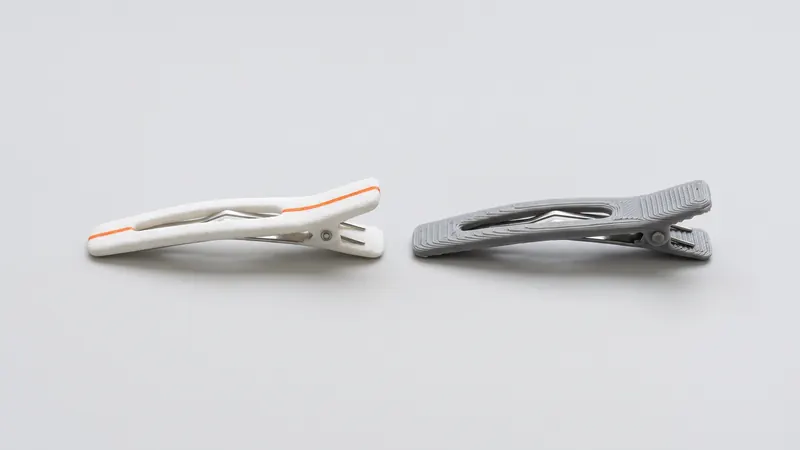
FDM (fused deposition modeling, also called FFF) is the 3D printing most people know: a nozzle lays down molten filament line by line. SLS (selective laser sintering) fuses nylon powder with a laser, layer by layer, inside a heated bed of powder. Both make plastic parts from a CAD file, but they suit different jobs. This comparison shows where each process is strong and how to decide for your part.
The short answer
Choose FDM for quick, simple, low-cost concept models and large simple shapes, especially if you print them yourself. Choose SLS when the part has to work: snap-fits, clips, housings, brackets, mechanisms, fixtures and small series that must look and behave the same from part to part.
How the two processes work
FDM melts a plastic filament in a heated nozzle and draws each layer as a path of lines. Overhangs need support structures, which are printed and then broken off. The strength of the part depends on how well each line bonds to its neighbors and to the layer below.
SLS spreads a thin layer of PA 12 powder over a heated bed and fuses the cross-section of the parts with a laser. Layer after layer, the parts grow inside the powder, which supports them. We print on an EOS FORMIGA P 110 Velocis with a chamber of 200 × 250 × 330 mm; EOS lists layers of 0.12 mm for the PA 2200 process. After printing, the parts are depowdered, blasted and polished. More in What is SLS 3D printing.
Side-by-side comparison
| Criterion | SLS (nylon PA 12) | FDM (filament) |
|---|---|---|
| Supports | None, the powder carries the parts | Needed for overhangs, removed by hand |
| Geometric freedom | Very high: channels, lattices, nested parts, moving assemblies | Limited by overhangs and support removal |
| Strength across layers | Fused cross-sections; moderate difference between directions | Clearly weaker across layers |
| Surface | Matte, slightly grainy, no extrusion lines | Visible lines and steps |
| Consistency in a series | High: all parts of a print job are processed together | Depends on printer and settings |
| Materials | Mainly nylons (we print PA 12) | Very wide range of filaments |
| Color | White base, dyed through the surface | Color of the filament |
| Best quantity | One part to small series, many parts per print job | One-offs and concept models |
| Lead time | Delivery speed chosen in the calculator, finishing included | Hours on your own printer |
Strength and toughness
An FDM part is a stack of extruded lines. Within a line the material is strong; between lines and between layers, the bond is the weak point. Clips or brackets loaded across the layers often split along a layer line.
In SLS, the laser fuses the whole cross-section of each layer, and the next layer fuses onto it. There is still a difference between directions, but a smaller one. For PA 2200, EOS gives a tensile strength of 48 MPa within the layers and 42 MPa across them, and an elongation at break of 18 % against 4 %. In practice, SLS nylon parts are tough, can take impacts and work well for snap-fits and clips. The PA12 nylon guide explains the material in more detail.
Accuracy and detail
For laser-sintered PA 12 the general tolerance we design to is ±0.3 % of the dimension with a lower limit of ±0.3 mm. SLS reproduces small features, thin ribs and text well and is consistent across a print job. FDM accuracy depends strongly on the printer, the material and the settings: a well-tuned machine can be very good on small, simple parts, but overhangs, supports and the nozzle width limit fine detail. Details in SLS tolerances and clearances.
Surface and appearance
FDM parts show their extrusion lines, and curved surfaces show steps; support contact areas are rough. SLS parts come out with a matte, slightly grainy surface. We glass-bead blast and polish every part in a DyeMansion Powershot DUAL, included in the price, which gives an even satin finish. Optional dyeing with TCN liquid dyes colors the surface layer without a coating: all 61 shades of the color catalog are priced instantly in the calculator. More in SLS post-processing and surface finish.
Cost: one part vs a print job full of parts
FDM is hard to beat for one simple part printed on your own desk. The cost logic of SLS is different: the price depends mainly on the volume of fused material, the space a part takes in the chamber and the finishing. Many parts are nested in one print job, supports cost nothing, and complexity is free. The more complex the part and the more parts you need, the better SLS compares. The guide to SLS 3D printing cost explains the price drivers.
Which process for which part?
| Part | Recommended | Why |
|---|---|---|
| Quick concept model, shape check | FDM | Fast and cheap, strength not critical |
| Large, simple bracket or cover, one piece | FDM or SLS | FDM if strength across layers is not critical |
| Snap-fit housing, clips | SLS | Toughness and even strength |
| Mechanism printed assembled | SLS | No supports inside joints |
| Jigs, fixtures, drill templates | SLS | Stiff, tough, accurate and repeatable |
| Small series of 10 to a few hundred parts | SLS | Nesting, consistency, finishing included |
| Part with internal channels | SLS | No supports to remove; powder must be able to escape |
For example, drill templates, jigs and fixtures and print-in-place hinges are typical SLS parts.
And other powder processes?
SLS is not the only powder-bed process for nylon. HP Multi Jet Fusion also prints PA 12, but its parts are gray because of the fusing agent, while SLS parts are white and take dyes in light and saturated colors. The comparison is in MJF vs SLS. Resin printing is compared in SLS vs SLA.
If you are unsure which process fits your design intent, the specialists at prototype.builders can help with the design and the prototype.
Frequently asked questions
Is SLS stronger than FDM?
For functional nylon parts, SLS parts are generally more uniform: the layers are fused across the whole cross-section, while FDM parts depend on the bond between extruded lines and are clearly weaker across the layers. A well-printed FDM part in a strong filament can still be sufficient for many uses.
Is SLS more expensive than FDM?
For a single simple part, FDM is usually cheaper. SLS becomes competitive for complex parts, for several parts at once and for small series, because many parts are nested in one print job and need no supports. The calculator shows the SLS price of your part instantly.
Does SLS need support structures?
No. The unfused powder supports the parts during printing. That allows overhangs, internal channels and assemblies printed in place without any support removal.
Which is more accurate, SLS or FDM?
SLS is generally more consistent on complex geometry. The general tolerance we design to for laser-sintered PA 12 is ±0.3 % with a lower limit of ±0.3 mm. A well-tuned FDM printer can be accurate on small, simple parts.
What does an SLS surface look like compared with FDM?
SLS parts have a matte, slightly grainy surface without visible extrusion lines. FDM parts show the lines of the nozzle and steps on curved surfaces. Our SLS parts are glass-bead blasted and polished, which gives an even satin surface.
When is FDM the better choice?
For quick concept models, large simple parts, low budgets for single pieces, and when you want to print in-house on your own desk. For tough functional parts, complex shapes and small series, SLS is usually the better choice.
Get an instant price
Upload STEP or STL files to the calculator and see the price of your parts in seconds: white Nylon PA 12, blasting and polishing included, optional dyeing in 61 colors, three delivery speeds. From there you send the order preview for confirmation.
Another material, an NDA or a large series? Write to us. For design help and prototype development see prototype.builders.
Get an instant price