
3D-Printed Gears in PA 12: Design, Limits and Lubrication
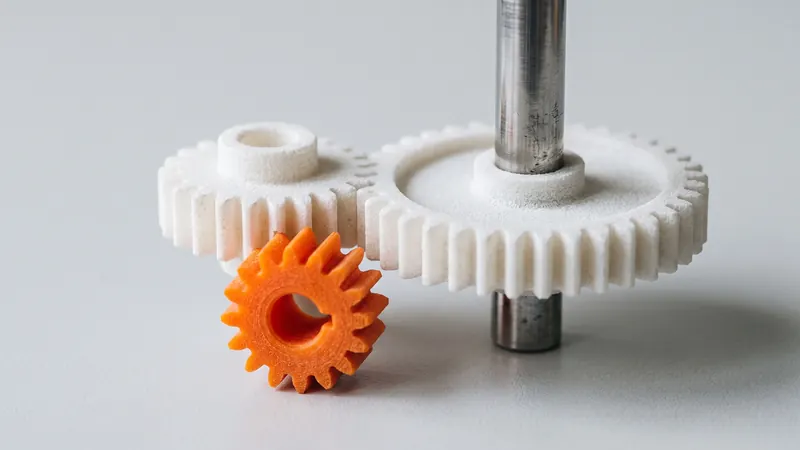
Nylon is one of the classic materials for plastic gears: it runs quietly, tolerates some misalignment and can run with little or no lubrication. Laser-sintered PA 12 adds design freedom: gears with integrated hubs, shafts, cams or housings, printed in one piece without a mold. This guide covers how to design SLS nylon gears that mesh well, what they can and cannot do, and when a molded or machined gear is the better choice.
Where SLS nylon gears make sense
- Prototypes of gearboxes and mechanisms, to test function before molding or machining.
- Light-duty mechanisms: adjusters, dials, drives of small devices, actuators with moderate loads.
- Test rigs, jigs and automation: custom gears that would be expensive to machine one by one.
- Spare parts for machines and devices where the original is no longer available.
- Integrated parts: a gear with a cam, a lever, a hub or a mounting flange in one piece.
The common factor: moderate loads, moderate speeds, and value in design freedom or speed. For a gear that has to transmit high torque continuously for years, a molded or machined gear made for that duty is usually the right choice.
What the material brings
PA 12 is a tough, low-friction polyamide with low moisture absorption, so its dimensions stay stable in humid air. For PA 2200, the powder we print, EOS gives a melting point of 176 °C, a tensile strength of 48 MPa within the layers and 42 MPa across them, and an elongation at break of 18 % against 4 %. Stiffness falls as temperature rises, so a gear that gets warm in operation carries less load. The PA12 nylon guide has the full picture.
| Property | Effect on gears |
|---|---|
| Toughness, elongation | Teeth tolerate shock and small misalignment |
| Low friction against steel and nylon | Can run dry at light loads, quiet |
| Lower stiffness than metal | Teeth deflect under load; keep loads moderate |
| Slightly porous, grainy surface | Some running-in; absorbs part of the lubricant |
| Stiffness falls with temperature | Watch heat from friction and the environment |
Design rules for SLS gears
Use standard involute geometry
Generate the tooth profile with your CAD gear tool rather than drawing it by hand. Standard involute gears mesh smoothly and are easy to replace later with molded or machined versions.
Prefer larger teeth
Layers are about a tenth of a millimeter thick (EOS lists 0.12 mm for the PA 2200 process) and the surface is slightly grainy. Very fine teeth lose their profile and carry little load. A larger module gives more accurate teeth and more strength; if space allows, choose the coarser gear.
Plan backlash and center distance
Our design guideline for laser-sintered PA 12 is a general tolerance of ±0.3 % with a lower limit of ±0.3 mm. Two printed gears that are designed with zero backlash will bind. Give the pair clearance in the mesh, and if the center distance is set by your housing, allow for the tolerance of both gears and the housing. For accurate shaft holes, design them to nominal and ream them after printing. More in SLS tolerances and clearances.
Make teeth wide enough
A wider face spreads the load. Plastic gears are usually made wider than steel gears for the same duty.
Design the hub for torque
A round bore on a smooth shaft will slip. Use a D-profile, a key, a hexagon or a clamping hub, or design for a metal insert (see threads and heat-set inserts in SLS PA 12). The torque the connection can carry depends on the geometry and the load; for critical drives, get the design reviewed.
Even walls, no solid lumps
Thick solid sections shrink more than thin ones as the part cools. A large gear with a solid disc may deviate more than one with a web and spokes or ribs. Keep the rim, web and hub thickness balanced.
Orientation
A gear printed with its face in the layer plane has teeth formed in the strongest direction and a clean tooth profile without layer steps. Print preparation chooses the orientation for the whole print job; if a gear is critical, mention it.
Lubrication, running-in and wear
- Dry running is possible at light loads and is one of the benefits of nylon gears.
- Lubrication reduces wear and noise at higher loads. Use a lubricant compatible with polyamide; the slightly porous surface absorbs part of it, so reapply after running-in.
- Running-in: the first hours smooth the contact surfaces. Expect a little fine dust.
- Pairing: a nylon gear running against a steel gear dissipates heat better than two nylon gears together.
- Heat is the main limit: friction heats the teeth and stiffness falls. Lower speed or load, or better heat removal, extends life.
Gear trains printed in place
Because SLS needs no supports, a whole gear train can be printed already assembled in its housing, with gears on integrated axles. The rules are the same as for any print-in-place assembly: at least 0.5 mm gap between moving surfaces and a path for the powder to escape. This is ideal for demonstrators and prototypes; for production mechanisms, separate gears on metal shafts are usually more precise.
Finishing and color
Every part is glass-bead blasted and polished in a DyeMansion Powershot DUAL, included in the price. According to DyeMansion, the process compacts the surface without removing material, so the tooth geometry is kept and the flanks become smoother. Dyeing with TCN liquid dyes is optional: it colors the surface layer, about 0.2 mm deep in PA 2200 according to DyeMansion, without adding a coating, so it does not change the mesh. Gears in an assembly can be color-coded with any of the 61 shades of the color catalog, each priced instantly in the calculator.
Checklist
- Involute profile from a CAD gear tool.
- Module as large as the space allows.
- Backlash and center distance allow for the ±0.3 % / ±0.3 mm guideline.
- Shaft holes designed to nominal and reamed if they must be accurate.
- Hub with D-profile, key, hexagon or insert for torque.
- Web and spokes instead of a solid disc on large gears.
- Moderate loads and speeds; heat considered.
- Test pair printed for a critical drive.
Load ratings and service life of plastic gears depend on the whole design intent. For drives that carry real load, the specialists at prototype.builders can review the design with you. For costs, see SLS 3D printing cost.
Frequently asked questions
Can you 3D print working gears in nylon?
Yes. Laser-sintered PA 12 gears work well for prototypes, mechanisms with moderate loads and speeds, test rigs, small series and spare parts. For high loads, high speeds or long continuous operation, check the design carefully and test it.
What backlash should SLS gears have?
More than a machined gear. Laser-sintered parts have a general tolerance of about ±0.3 % with a lower limit of ±0.3 mm (our design guideline), and the surface is slightly grainy, so the gear pair needs clearance in the mesh and in the center distance. Test the pair before relying on it.
Do SLS nylon gears need lubrication?
Nylon gears can run dry at light loads, which is one of their advantages. Lubrication reduces wear and noise at higher loads. Choose a lubricant that is compatible with polyamide and remember that the slightly porous SLS surface absorbs some of it.
What is the minimum module for 3D-printed gears in SLS?
There is no fixed minimum, but very fine teeth lose their shape because of the layer thickness and the grainy surface. Larger teeth print more accurately and carry more load. For small modules, print a test pair first.
How should a gear be oriented in the printer?
Ideally with the gear face within the layer plane, so each tooth is formed by the layers in its strongest direction and the tooth profile is not stepped. Print preparation chooses the orientation for the whole print job; mention it if the gear is critical.
Can a gear be printed together with its shaft?
Yes. SLS can print a gear with an integrated shaft, or a gear train already assembled in its housing, with gaps of at least 0.5 mm and an escape path for the powder.
Get an instant price
Upload STEP or STL files to the calculator and see the price of your parts in seconds: white Nylon PA 12, blasting and polishing included, optional dyeing in 61 colors, three delivery speeds. From there you send the order preview for confirmation.
Another material, an NDA or a large series? Write to us. For design help and prototype development see prototype.builders.
Get an instant price