
Watertight 3D-Printed Parts: What SLS PA 12 Can and Cannot Do
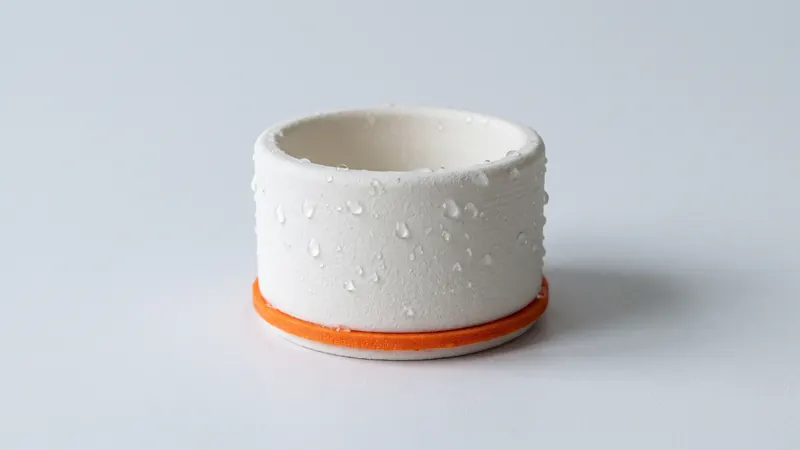
Housings for outdoor electronics, fluid channels, containers and covers often have to keep water in or out. Laser-sintered PA 12 absorbs little water, but a printed wall is not the same as a molded one. This guide explains honestly what is possible with SLS parts, how to design them so they have the best chance of being tight, and where a seal, a coating or another process is needed.
The short answer
SLS PA 12 parts are not automatically watertight. Sintered nylon has a slightly porous structure, and thin walls can let water seep through, especially under pressure. Thicker walls, careful design and seals improve the result a lot, but tightness has to be tested on the real part. We print, blast, polish and optionally dye parts; we do not seal them and do not certify IP ratings.
Why sintered parts can leak
In laser sintering, the powder grains are fused but not pressed together as in injection molding. The result is a dense part with a small share of fine pores, and a surface that is matte and slightly grainy. Whether water gets through depends on:
- Wall thickness: a thin wall offers a short path through the pores; a thicker wall is far more likely to hold water.
- Pressure: splashes and rain are much easier to keep out than water under pressure or a long immersion.
- Time and liquid: other liquids can behave differently from water, and a wall that is dry after minutes may show moisture after days.
- Joints: most leaks in enclosures come from the joint between lid and base, cable entries and screws, not from the wall itself.
The material itself takes up little water. EOS gives a water absorption of 0.52 % at 23 °C and 50 % relative humidity for PA 2200, the powder we print, which is low for a nylon; see PA 12 heat, chemical and UV resistance.
What helps: design rules
- Thicker walls where water is held. Thin walls near the 0.8 mm limit (the calculator warns below it) are the least likely to be tight. Walls that must hold water should be clearly thicker than the 1.5 to 3 mm used for ordinary housings.
- Even walls, no sudden jumps. Uniform walls cool evenly and avoid weak zones; round inside corners.
- Few joints. SLS can print a channel or container in one piece, without glued or welded seams. Use that.
- Design for a seal. Plan gaskets, O-rings or sealing compound from the start instead of relying on the printed wall alone.
- Escape holes: hollow parts need at least two escape holes of at least 5 mm per closed cavity to release the powder. Place them where they can be plugged or sealed afterwards if the part must be closed. See hollow parts and escape holes.
Seals, gaskets and O-rings
For enclosures, the joint is usually the critical part. A lip and groove with a soft gasket, or a groove for an O-ring, works with printed parts if the sealing faces are designed with care:
- The printed surface is matte and slightly grainy. Soft, thick gaskets and foam seals cope with it better than thin O-rings.
- Where an O-ring must seal reliably, consider facing or finishing the sealing surface after printing, or sealing that face.
- Clamp evenly with enough screws; use metal threaded inserts so the screws keep their preload.
- Cable entries need proper cable glands, not just a tight hole.
More on housing design in 3D-printed enclosures.
Sealing the material: options we do not offer
Several post-treatments can close the pores of sintered parts, for example impregnation, infiltration with resins, coatings or chemical vapor smoothing. We do not offer any of them. Our finishing is glass-bead blasting and polishing in a DyeMansion Powershot DUAL, included with every part, and optional dyeing with TCN liquid dyes. Polishing makes the surface more even, and dyeing colors the surface layer, but neither step seals the part. If you need a sealed surface, a specialist can treat the parts after delivery; ask them about compatibility with dyed PA 12. More in SLS post-processing explained.
IP ratings and pressure
An IP rating describes a finished, assembled product and is proven by testing that product. A printed housing can be part of a product that reaches a rating, but the rating depends on the whole design, the seals and the assembly. We do not test or certify IP ratings. For parts under pressure, such as fluid manifolds or pressurized containers, test thoroughly, consider sealing treatments or choose another process.
How to test a printed part
- Fill test: fill the part with water, close it and leave it standing for the time it must hold water; check the outside with dry paper.
- Immersion test: for housings, immerse the closed assembly and check inside for moisture afterwards.
- Pressure test: apply the real pressure with some margin and watch for drops or bubbles.
- Repeat with the real liquid and temperature, not only with cold water.
Order one or two test parts first; in SLS every part of an order goes through the same print job and finishing, so later parts behave alike.
Typical applications and what to expect
| Application | What usually works | Needs extra care |
|---|---|---|
| Splash-protected housings | Lip and groove with a soft gasket, cable glands | Immersion or pressure |
| Drainage, guides, covers | Printed directly | Long-term contact with water under pressure |
| Containers and trays | Thick, even walls for short-term use | Permanent storage of liquids |
| Fluid channels and manifolds | Prototypes and low-pressure functional tests | Pressure and long service; seal or choose another process |
| Parts in contact with drinks or food | See is PA 12 food safe? | Porosity, cleaning and compliance |
If your project depends on tightness and needs engineering and testing, the specialists at prototype.builders can help with the design and the prototypes.
Frequently asked questions
Are SLS 3D-printed parts waterproof?
Not automatically. Sintered PA 12 has a slightly porous structure, so thin walls can let water seep through, especially under pressure. Thicker walls, seals and testing on the real part are needed for tight parts.
Do you seal or coat SLS parts to make them watertight?
No. We blast and polish every part and offer optional dyeing; neither step seals the part. Impregnation, infiltration, coatings or vapor smoothing would have to be done by a specialist after delivery.
Can a 3D-printed housing reach an IP rating?
A printed housing can be part of a product that reaches a rating, but an IP rating is a property of the finished, assembled product and must be tested on it. We do not test or certify IP ratings.
What wall thickness makes an SLS part watertight?
There is no thickness that guarantees it. Thicker walls are much more likely to hold water than thin ones; walls that must hold water should be clearly thicker than the 1.5 to 3 mm of ordinary housings, and the part must be tested.
Does PA 12 absorb water?
Little. EOS gives a water absorption of 0.52 % at 23 °C and 50 % relative humidity for PA 2200, low for a nylon, so parts keep their dimensions in humid conditions.
Can O-rings seal against a printed surface?
Sometimes, but the matte, slightly grainy surface makes it harder. Soft, thick gaskets cope better; for reliable O-ring seals, finish or seal the sealing face after printing and test the assembly.
Get an instant price
Upload STEP or STL files to the calculator and see the price of your parts in seconds: white Nylon PA 12, blasting and polishing included, optional dyeing in 61 colors, three delivery speeds. From there you send the order preview for confirmation.
Another material, an NDA or a large series? Write to us. For design help and prototype development see prototype.builders.
Get an instant price