
Is PA 12 Food Safe? 3D Printing for Food Contact, Explained Carefully
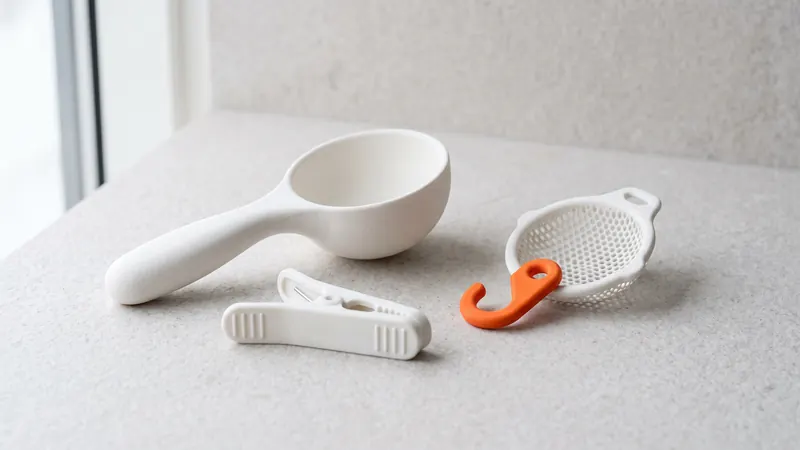
Food-safe 3D printing is one of the most searched questions about printed plastics, and one of the most often answered too simply. For laser-sintered PA 12 the honest answer has two parts: what the material maker states about the powder, and what that does and does not mean for the part you hold in your hand. This guide separates the two, explains why surface porosity and cleaning matter, and shows how to decide whether an SLS part fits your food-related application.
The short answer
For PA 2200, the PA 12 powder we print on our EOS FORMIGA P 110 Velocis, EOS states compliance with Regulation (EC) No 1935/2004, Regulation (EU) No 10/2011 and good manufacturing practice (GMP), and says its documentation supports the certification of end products through migration tests. That makes PA 2200 a sensible starting point for food-related parts. It does not make every printed part automatically food safe: the finished part, its surface, its cleaning and its use decide.
| Question | What is known | Who answers it |
|---|---|---|
| Is the powder suitable for food contact? | EOS states EC 1935/2004, EU 10/2011 and GMP compliance for PA 2200 | The material maker (EOS) |
| Is this printed part suitable for this use? | Depends on geometry, surface, cleaning, food type, contact time and temperature | Whoever places the part on the market or uses it |
| Is the finished part compliant? | Shown by an assessment of the part, often including migration testing | The manufacturer of the end product, with an accredited laboratory |
What EOS states about PA 2200
EOS describes PA 2200 as compliant with the European framework regulation for food-contact materials (EC 1935/2004), the regulation on plastic materials intended to come into contact with food (EU 10/2011) and good manufacturing practice. According to EOS, its documentation supports end-product certification through official migration tests, and detailed ingredient information is available to laboratories on request.
EOS also tests its biocompatible polymer materials for cytotoxicity, sensitization, irritation and acute systemic toxicity, and adds an important sentence: the biocompatibility of a material does not allow any direct conclusion to be drawn about the produced part. The same logic applies to food contact. A compliant material is the first condition, not the last.
Why the finished part is a separate question
Surface porosity
Laser-sintered parts are built from fused powder grains. The surface is slightly porous and has a fine grain, even after our glass-bead blasting and polishing in a DyeMansion Powershot DUAL, which according to DyeMansion compacts the surface. Pores and grain give food residues, moisture and microorganisms more places to stay than the smooth skin of an injection-molded part. For short, dry contact this matters little; for wet, fatty or long contact, or parts that must be cleaned hygienically, it matters a lot.
Cleaning
A part that touches food again and again must be cleaned reliably. Rough or porous surfaces, narrow gaps, blind holes and lattice structures are hard to clean. Heat, detergents and repeated cycles also act on the material. Whether a part survives your cleaning process, and stays clean, has to be tested on the part.
Dyeing
We dye parts with TCN liquid dyes; according to DyeMansion, the dye penetrates about 0.2 mm into PA 2200. That adds another substance to the surface. EOS's statements refer to the PA 2200 material, not to dyed parts. If food contact matters, tell us before you order a dyed part.
Conditions of use
EU 10/2011 compliance is always tied to conditions: the type of food, the contact time, the temperature and the ratio of surface to food. A material that is fine for brief contact with dry food at room temperature is not automatically fine for hot, fatty or acidic food over hours.
Responsibility: who confirms that a part is food safe?
Under EU rules, the business that places a food-contact article on the market, or uses it in food production, is responsible for its compliance. In practice that means: the material documentation from EOS, an assessment of the finished part for its intended use, and where needed a migration test of the finished part by an accredited laboratory. We print the parts from PA 2200; we do not certify finished parts for food contact. If your application needs documentation, ask us before you order.
Where SLS PA 12 makes sense around food
| Application | Typical contact | Fit |
|---|---|---|
| Prototypes of kitchen products and packaging (shape, ergonomics, assembly) | None or test only | Very good |
| Machine parts near food: covers, brackets, sensor holders | Indirect | Very good |
| Format parts, guides, gripper fingers in packaging lines | Short, often dry or packaged | Good, after assessment of the use |
| Tools with repeated direct contact (scoops, cutters, molds) | Direct, repeated | Only with a tested cleaning process and confirmed compliance |
| Containers for wet, fatty or hot food over long periods | Long, demanding | Usually better made by molding or machining |
Design tips for food-related SLS parts
- Keep surfaces that touch food smooth and open: no lattices, deep grooves or blind holes there.
- Round inner corners so they can be cleaned.
- Avoid narrow gaps between parts where residues collect; print-in-place joints are hard to clean.
- Keep wall thickness even and robust enough for cleaning and handling.
- Order natural white if food contact matters, and discuss any dyed version first.
- Plan a test: the finished part, cleaned the way it will be cleaned, in contact with the real food.
Checklist before you order
- What food, how long, at what temperature, how often?
- How is the part cleaned, and how often?
- Does the surface touching food have to be cleaned hygienically?
- Who places the finished article on the market, and what documentation do they need?
- Is a migration test of the finished part required?
- Natural white or dyed?
More about the material in the PA12 nylon guide, about the surface in SLS post-processing and surface finish and about colors in dyeing SLS parts. If the design has to be adapted for hygiene, the specialists at prototype.builders can help.
Frequently asked questions
Is PA 12 food safe?
For PA 2200, the PA 12 powder we print, EOS states compliance with Regulation (EC) No 1935/2004, Regulation (EU) No 10/2011 and good manufacturing practice. That is a statement about the material. Whether a finished part is suitable for a specific food-contact use depends on the part, its surface, its cleaning and its use, and must be confirmed for that part.
Can I use SLS parts for food production equipment?
Often yes, for example guides, format parts, gripper fingers or test tools, provided the use has been assessed. The slightly porous surface is harder to clean than a molded one, so contact time, food type and cleaning need to be considered and, where required, tested.
Who is responsible for food-contact compliance of a printed part?
Whoever places the finished article on the market or uses it in food production. The material maker's documentation supports that assessment, for example through migration testing of the finished part, but it does not replace it.
Are dyed SLS parts food safe?
Dyeing adds another substance to the surface. The statements EOS makes for PA 2200 refer to the material, not to dyed parts. If food contact matters, discuss it with us before ordering a dyed part.
Are SLS PA 12 parts dishwasher safe?
There is no general answer. Heat, detergents and repeated cycles act on the slightly porous surface and on the material properties. Test the finished part under the conditions it will see before relying on it.
Is PA 12 biocompatible?
EOS states that its biocompatible polymer materials are tested for cytotoxicity, sensitization, irritation and acute systemic toxicity, and points out that the biocompatibility of a material allows no direct conclusion about the produced part. The same caution applies to food contact.
Get an instant price
Upload STEP or STL files to the calculator and see the price of your parts in seconds: white Nylon PA 12, blasting and polishing included, optional dyeing in 61 colors, three delivery speeds. From there you send the order preview for confirmation.
Another material, an NDA or a large series? Write to us. For design help and prototype development see prototype.builders.
Get an instant price