
SLS 3D Printing vs CNC Machining: Which Is Better for Plastic Parts?
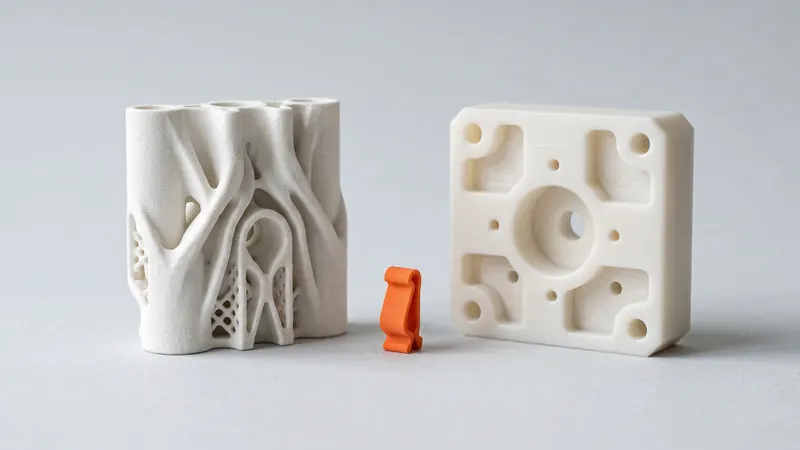
A plastic part for a machine, a fixture or a prototype can be laser-sintered from nylon powder or milled from a solid block. Both processes make functional parts without a mold, but they are good at very different things. This guide compares SLS 3D printing and CNC machining on geometry, accuracy, surface, material, quantity and lead time, and shows when the best answer is to combine them.
The short answer
Choose SLS when the part is complex, has internal channels, undercuts or organic shapes, when several parts can be merged into one, or when you need several pieces or variants quickly. Choose CNC machining when the part needs tight tolerances, smooth sealing or sliding faces, a specific plastic other than PA 12, or is a simple prismatic block. Many good designs use both: a printed part with a few machined features.
How the two processes work
SLS (selective laser sintering) builds the part layer by layer from nylon powder. A laser fuses each cross-section, and the surrounding powder supports the part, so no support structures and no tool access are needed. We print white PA 12 from EOS's PA 2200 powder on an EOS FORMIGA P 110 Velocis. More in what SLS 3D printing is.
CNC machining removes material from a solid block with rotating cutters. Every surface must be reachable by a tool, inside corners keep at least the radius of the cutter, and the part has to be clamped and often turned over for a second setup.
Side-by-side comparison
| Criterion | SLS (PA 12) | CNC machining (plastics) |
|---|---|---|
| Geometry | Almost any shape: internal channels, undercuts, lattices, merged assemblies | Limited by tool access; inside corners keep the cutter radius |
| Accuracy | Our design guideline: ±0.3 %, at least ±0.3 mm | Much tighter tolerances are achievable on critical features |
| Surface | Matte, slightly grainy after glass-bead blasting and polishing | Smooth, with fine tool marks; sealing faces possible |
| Materials | We print PA 12 only (white, dyeable in 61 colors) | Wide choice of plastic stock, such as POM, PA 6, PE, PEEK or acrylic |
| Material properties | Somewhat lower in the build direction (EOS: 48 MPa within the layers, 42 MPa across them) | Those of the stock material |
| Preparation | Upload STEP or STL, no programming or fixtures | Toolpath programming, clamping, often several setups |
| Several parts | Many parts and variants share one print job | Each part is machined one after another |
| Size | Up to 200 × 250 × 330 mm in our printer | Depends on the machine; large plates and blocks are common |
| Material use | Only the part is fused; unfused powder is partly reused | Much of the block can end up as chips |
When SLS is the better choice
- Complex shapes: internal ducts, cable channels, curved surfaces and ribs that would need many setups or could not be machined at all.
- Merged assemblies: a bracket, a clip and a cable guide printed as one part instead of three machined parts and screws.
- Snap-fits and hinges: tough PA 12 suits snap-fit joints and print-in-place hinges.
- Variants and several pieces: different versions of a fixture or ten copies of a housing are simply more parts in the same order.
- Light parts: hollow sections and pockets cost nothing extra to make; EOS gives a density of 0.93 g/cm³ for PA 2200.
- Fast iteration: no programming and no fixtures, so a changed design is a new upload and an instant price.
When CNC machining is the better choice
- Tight tolerances: precise bores, bearing seats and mating faces that must hold tighter than our ±0.3 % guideline.
- Smooth functional surfaces: sealing faces, sliding guides and optical or transparent parts.
- Specific materials: POM for low friction, PEEK for high temperatures, transparent acrylic, or a material demanded by a specification.
- Simple blocks and plates: a flat plate with a few holes is quick to mill and has no geometry SLS would improve.
- Parts larger than the chamber: when splitting the part is not acceptable.
The hybrid workflow: print, then machine what matters
Many functional parts need a complex body but only a few precise features. A common approach is to print the part in SLS and machine only those features afterwards:
- Bores: print them slightly undersize and ream or drill them to the final size.
- Threads: tap them in the printed part or use metal threaded inserts.
- Mating faces: leave a small machining allowance on the faces that must be flat or square to each other, and face them after printing.
- Mixed assemblies: a machined base plate or shaft combined with printed brackets, covers and guides.
Our tolerance guide explains which fits work straight from the printer. If a project needs both printed and machined parts designed together, the specialists at prototype.builders can help with the design and the prototypes.
Designing for one or the other
A part designed for milling often looks blocky: flat faces, straight pockets and generous material so it can be clamped. When such a part moves to SLS, it can usually lose material: replace solid sections with ribs, merge separate pieces, and add fillets where the cutter no longer dictates the corner radius. Two SLS rules to keep: walls of at least about 0.8 mm (the calculator warns below that), and at least two escape holes of at least 5 mm for every closed cavity. The SLS design guidelines cover the rest.
The other way round, a part designed for SLS with internal channels or lattices may be impossible to machine without splitting it into several pieces.
Quick decision guide
| Your part | Usually best |
|---|---|
| Complex bracket, duct, housing or fixture in nylon | SLS |
| Several variants or pieces needed quickly | SLS |
| Precise bores or sealing faces on a complex body | SLS plus machining of those features |
| Simple plate or block with a few holes | CNC machining |
| POM, PEEK, transparent or other specified plastics | CNC machining |
| Tight tolerances on most surfaces | CNC machining |
Frequently asked questions
Is SLS 3D printing cheaper than CNC machining?
It depends on the part. Complex shapes, merged assemblies and several pieces or variants usually favor SLS, because complexity costs little and no programming or fixtures are needed. Simple blocks and plates are often quicker to mill. Upload the model to the calculator to see the SLS price instantly.
Is SLS as accurate as CNC machining?
No. Our design guideline for laser-sintered PA 12 is ±0.3 % with a lower limit of ±0.3 mm. CNC machining can hold much tighter tolerances on critical features, so precise bores and faces are often machined after printing.
Can SLS parts be machined after printing?
Yes. PA 12 can be drilled, reamed, tapped and faced. Leave a small machining allowance on the features you want to machine and print bores slightly undersize.
Which plastics can be CNC machined but not printed by you?
We print PA 12 only. Materials such as POM, PEEK, PA 6, PE or transparent acrylic are typically machined from stock.
Are SLS parts as strong as machined nylon?
Laser-sintered PA 12 is close to many molded or machined plastics, but somewhat weaker in the build direction: EOS gives 48 MPa within the layers and 42 MPa across them for PA 2200. Machined parts have the properties of the stock material.
Should I redesign a machined part for SLS?
It usually pays off. Replace solid sections with ribs, merge separate pieces, round the corners, keep walls above about 0.8 mm and give every closed cavity at least two escape holes of at least 5 mm.
Get an instant price
Upload STEP or STL files to the calculator and see the price of your parts in seconds: white Nylon PA 12, blasting and polishing included, optional dyeing in 61 colors, three delivery speeds. From there you send the order preview for confirmation.
Another material, an NDA or a large series? Write to us. For design help and prototype development see prototype.builders.
Get an instant price